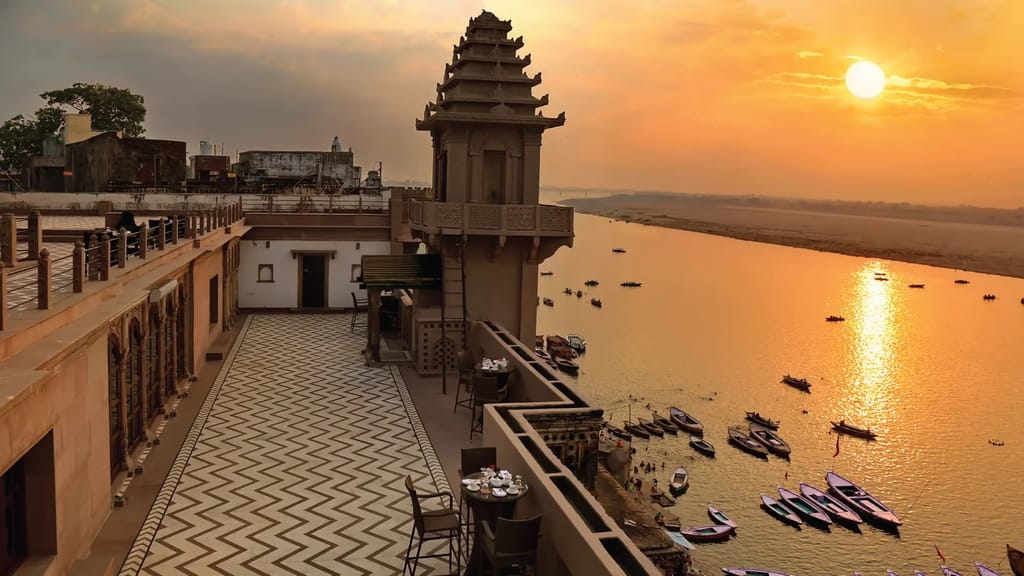
Most hotels tell you which motorway exit to take. BrijRama Palace's own FAQ says something better: the best way to reach the property is by boat. You board at Assi Ghat or Namo Ghat, or ride the roughly twenty minutes from Rajghat, and Varanasi assembles itself along the waterline, ghat by ghat, until a sandstone palace of turrets and a central tower rises ahead. That is the front door.
The palace went up in 1812, built by Sridhara Narayana Munshi, a finance minister in the estate of Nagpur, in sandstone carried from Chunar, with porches and Greek pillars. The hotel calls the architecture a nod to the Maratha dynasty, and calls itself, with unusual restraint for this city, the second oldest palace in Varanasi. In a place where every second doorway claims a millennium, that precision is oddly reassuring.
The riverbank remembers the building's owners. When the palace was new, the steps below it were named Munshi Ghat, after the man who built it. In 1915 the ghat passed to the royal house of Darbhanga in Bihar, which extended it, and the extension became known as Darbhanga Ghat, the name on the hotel's address today. Walk the waterfront and you can still read MUNSHIGHAT painted on the wall next door: two names, one building, both true.
Eighteen years to bring it back
In 1994 the Clarks hotel group bought the Darbhanga palace and gave it the name BrijRama. Brijpal Das is credited with acquiring the property and dedicating eighteen years to its restoration. The palace now appears in the MICHELIN Guide's hotel selection.
Sitar with sunrise
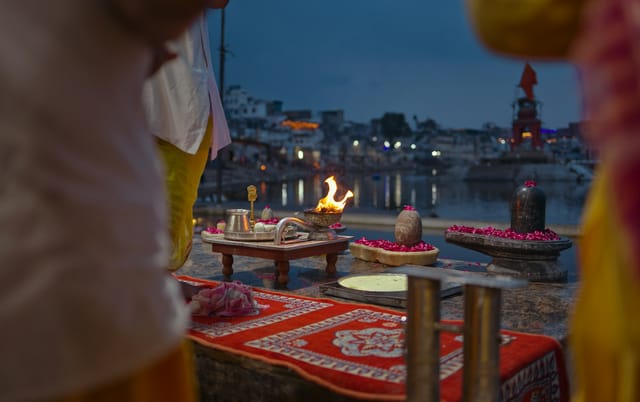
The palace's daily rhythm is set to live music, and it is included in the stay. Every morning between eight and nine, musicians play Indian classical ragas on sitar, tabla and flute; evenings bring a forty-five minute Kathak recital at a quarter to eight. Sunrise yoga happens up on the Udayan Terrace. Guests also get what the palace calls a front-row seat at the evening Ganga aarti at Dashashwamedh Ghat, arranged without charge.
For the full riverine flourish there is dinner aboard a bajra, a traditional decorated wooden boat, at ₹8,000 plus taxes a head, and a dawn outing to the Subah-e-Banaras aarti at Assi Ghat for ₹2,500 plus taxes (rates as published by the hotel, mid-2026).
Which rooms at BrijRama Palace have a Ganges view?
Here is the honest detail buried in the hotel's own FAQ: only the Maharaja Suite and the Varuna Burj rooms have the Ganges view. The Varuna Burj suites sit in the semi-circular extension of the palace wall with what the hotel describes as a 180-degree sweep of city and river; the Maharaja Suite adds a clawfoot bathtub. The rooms run in categories with names like Vasundhara, where carpets from Bhadohi and Banarsi art do the welcoming. The lesson writes itself: book the Burj.
Dinner, three families deep
There are three places to eat: Darbhanga, the all-day restaurant; the Udayan Terrace, where the cultural performances happen over a view of the city; and Aangan, whose ten-course tasting menu tells the building's own story, opening with three courses inspired by the Maratha dynasty, then courses honouring the Darbhanga royal family and the Kumar family. The Kashi Vishwanath temple is about 800 metres away, and the hotel runs complimentary shared shuttle boats to and from Rajghat and Assi Ghat on a daily timetable.
The overview page promises "an oasis of serenity, just moments away from Varanasi's most cherished landmarks", which is the sentence every hotel writes. The unstandard part is everything else: what the hotel itself calls the city's second oldest palace, entered from the water, where the day starts with a sitar and ends with an aarti. Varanasi is not short of places to stay. It has exactly one of these.
Rooms, rates and the enquiry form are on the Brijrama Palace stay page.