An hour from the Taj Mahal, the crowds simply stop. Drive 64 kilometres from Agra, past Bah, and you arrive at a bougainvillea-draped gateway with a carved stone sign: Mela Kothi, The Chambal Safari Lodge. The family dates the kothi to the late 1860s, when Rai Saheb Ch. Suraj Pal Singh, zamindar of Jarar, built it as the camp office for his family's twice-yearly cattle fair, a mela grand enough to draw traders from Maharashtra and Orissa. The family traces its hold on Jarar to 1472. The fair faded, and by the 1990s the house and its grounds had slipped into neglect.
The Chambal has a reputation problem, and the lodge tells the story better than anyone: an enraged Draupadi, wagered and lost over a roll of dice in the Mahabharata, cursed the river for standing mute witness to her humiliation. Legend hardened into geography. The ravines, the Chambal Behad, became the refuge of Baghis and dacoit gangs, swelled by rebel sepoys after 1857, and for generations sensible people stayed away.
Here is the flip that makes this place worth writing about: a river everyone avoided was a river left in peace. The Chambal kept flowing quietly through its badlands, and in 1979 a 400 kilometre stretch of it became the National Chambal Sanctuary, 1,235 square kilometres of protected river and ravine set aside to save the gharial from extinction.
Boats past basking gharials
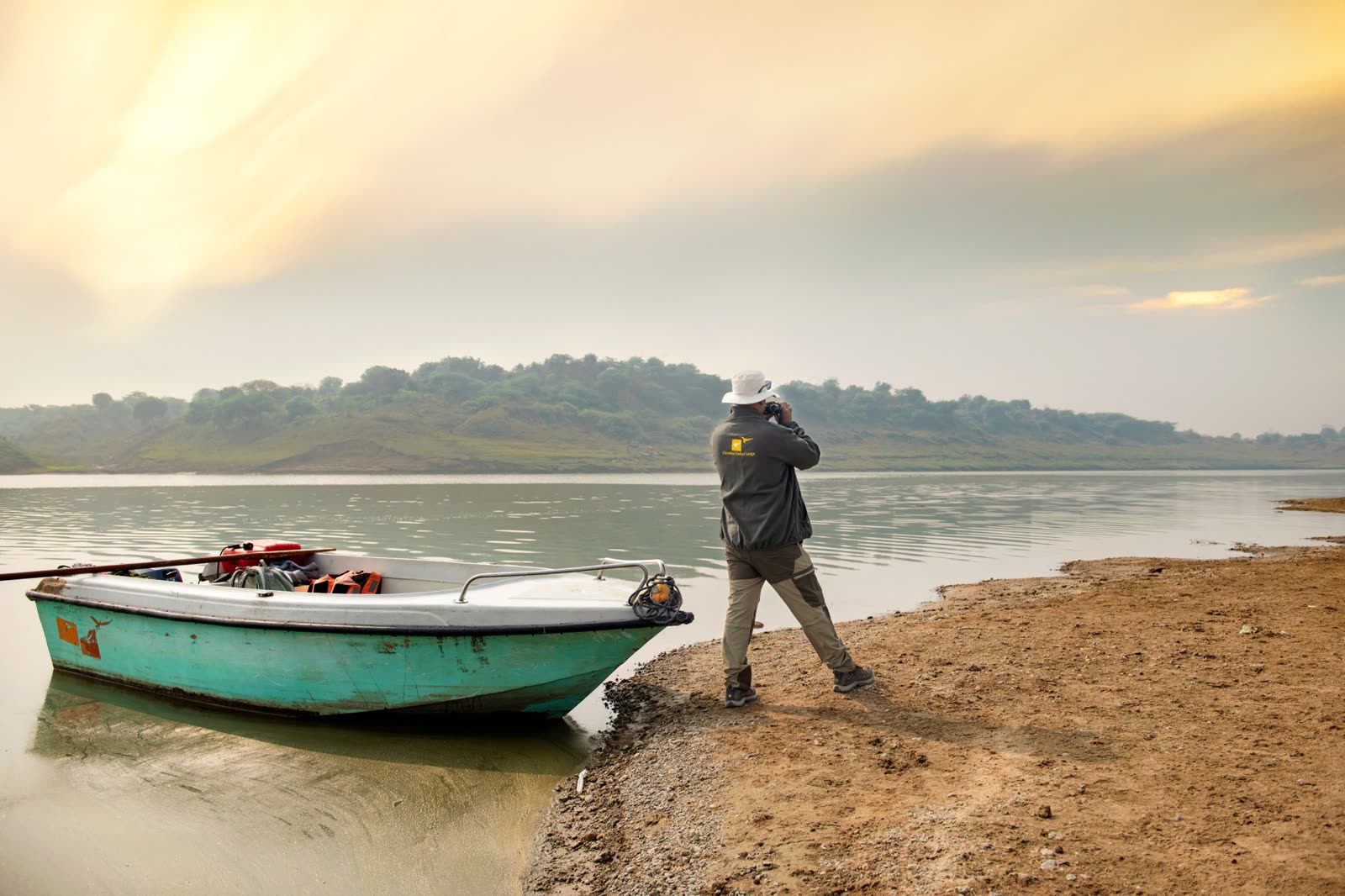
The sanctuary access point is 22 kilometres from the lodge, and the boat is the whole point. The lodge's skilled boatmen drift you past what their sanctuary pages tally as 1,700 gharials and 400 marsh crocodiles, along one of the last stretches of river anywhere that still holds the Gangetic river dolphin. Eight species of turtle live here, smooth-coated otters, and a bird list of over 330 species, with a growing reputation as one of the most reliable places to see the Indian skimmer. Independent accounts go further and call this river home to nearly ninety percent of the world's remaining wild gharials. You will share it with almost nobody.
An engineer, a scientist, and a derelict kothi
In 1999 the founder's great-grandson Ram Pratap Singh, an IIT engineer, came back to the family estate with his wife Anu Dhillon, an environmental scientist. They restored the abandoned kothi over five years and regenerated some thirty odd acres of grounds into man-made forest, orchards and grassland. The rewilding worked on the small scale as thoroughly as the sanctuary worked on the large: the lodge's own checklist now records more than 198 species of birds, reptiles and mammals without leaving the property. They fund the Chambal Conservation Foundation themselves, have fuelled the Forest Department's anti-poaching patrols since 2009, and have put close to 20,000 schoolchildren through conservation programmes. In 2023 the lodge won TOFT's John Wakefield Memorial Award for Most Inspirational Eco Lodge.
Fourteen rooms and daily menus from the farmers' market
The lodge itself is fourteen rooms and cottages scattered through the trees, with verandahs, courtyards, a library and gardens, and meals served against the backdrop of a restored stable block. The kitchen writes its menus each morning from whatever is good at the local farmers' market or growing on the family farms. The factsheet is charmingly honest about rural Uttar Pradesh: the power flickers, silent generators and solar lamps pick up the slack, and the WiFi is complimentary, confined to the lounge and garden, and cheerfully described by the lodge itself as somewhat erratic. That is rather the point of coming.
Beyond the river
Jeep safaris run 30 kilometres into the ravines for blackbuck and dry-land birds like the Indian courser, or out to a reserve the lodge describes as the breeding ground of India's largest congregation of sarus cranes. Night walks around the grounds turn up civet cats, jackals, hedgehogs and, for the lucky, a striped hyena. The Bateshwar temples, forty and more white Shiva shrines along the river ghats, are close by, and around Diwali they host what the lodge calls India's second largest animal fair. There is even a 207 kilometre bicycle highway that starts behind the Taj Mahal and runs to Etawah; the lodge's own access road is part of it.
Agra airport is about ninety minutes away, Delhi around five hours. Most guests come for the river and stay for the quiet: the Taj Mahal and its crowds an hour away, and here, a slow brown river the legends kept empty, where the critically endangered gharial suns itself on the sandbanks in something close to privacy.