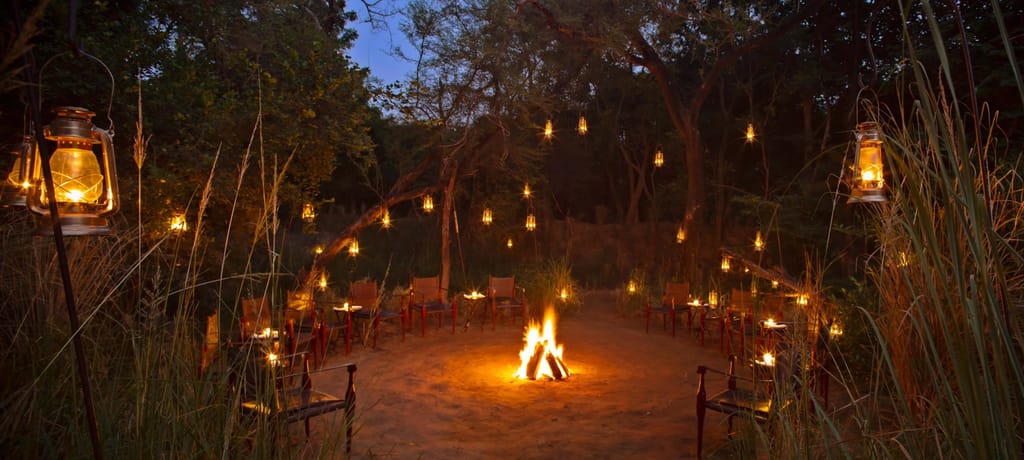
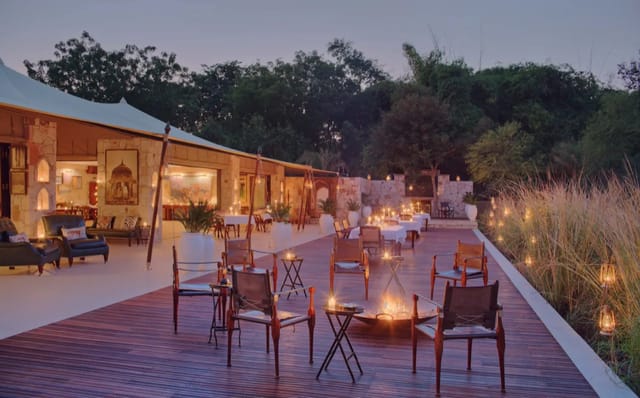
There is a reason the campaign tent keeps its hold on the travelling imagination, and it has nothing to do with roughing it. Done properly, canvas is the most honest kind of luxury: everything in the room earns its place, and the wall between you and the jungle is thin enough to remind you why you came. Few places in India do it more properly than SUJÁN Sher Bagh, a camp of twelve tented suites pitched on the edge of Ranthambhore National Park in Rajasthan, the reserve the camp calls India's most celebrated tiger country.
Every good camp has a founding story. Few can match this one. In the mid-1970s, Tejbir and Malvika Singh arrived in Ranthambhore after dark, guided, as the family tells it, by the dim flicker of a paraffin lantern burning at the ruin of Jogi Mahal. They were welcomed by Fateh Singh Rathore, the reserve's legendary warden, pitched their two-roomed tent beneath the famous banyan tree, and woke to find the pug marks of a tiger all around their fragile bedroom.
Their son Jaisal grew up with the scents and sounds of this jungle as boyhood companions. His maternal uncle was Valmik Thapar, one of India's most formidable tiger conservationists, who in 1988, together with Jaisal's parents and other friends, founded the Ranthambhore Foundation to preserve the park through community conservation. So when Sher Bagh opened in 2000, pitched within the family's private farm on the periphery of what is now the Ranthambhore Tiger Reserve, it was less a hotel launch than a homecoming. By the camp's account, Tatler listed it among the top 100 hotels in the world within a year, and in 2008 it became the first tented property in India invited to join Relais & Châteaux.
Twelve tents, one idea
The tents themselves transport you, in the camp's own phrase, to the glamorous 1920s, and the conviction runs deeper than styling. Each suite is kitted out with campaign furniture made for the camp, the portable kit of the old safari. One is named for Machhli, the famous tigress whose territory once included the very ground the camp stands on, which is the sort of provenance no designer can fake. The rest of the inventory, brass bathtubs included, belongs to the Sher Bagh stay page.
Campfire society
Evenings here belong to the fire. You come back from the park to a crackling campfire and an Anglo-Indian dinner built on the camp's homegrown organic produce; homegrown produce has fed a farm-to-table menu for, the camp says, over a quarter of a century, and if you ask, a cooking class will teach you the family recipes over open flames. Days belong to the jungle. Ranthambhore is, the camp argues, perhaps the finest place in the world to observe wild tigers, and the supporting cast of leopard, sloth bear and, by the camp's count, more than 300 species of birds is no hardship either. Its drivers and guides carry what the camp reckons is a combined 150 years of experience into every drive. The UNESCO-listed Ranthambhore Fort and the Dastkar women's craft collective wait for the culturally inclined.
The part you cannot see
SUJÁN describes Sher Bagh as India's first positive impact safari camp, and the group publishes concrete numbers behind it. Some 82 per cent of the group's staff come from Rajasthan, most from rural communities. The group supports 12 schools teaching 10,842 students, and 20,000 people have annual access to free medical care through its mobile medical unit. All its camps hold Platinum LEED certification. The camp counts Tiger Watch among its conservation partners, and a collaboration with Elizabeth Scarlett funded a new anti-poaching patrol unit for Ranthambhore's Village Wildlife Watch.
That is the real romance of Sher Bagh. The lantern that guided the Singhs into Ranthambhore more than fifty years ago has, in effect, never gone out. You simply get to sit beside it.
The practical bit
Ranthambhore's railhead is Sawai Madhopur, a short drive from the camp; Jaipur's airport is the usual flying route in, around three hours by road. The thing to plan around is the calendar: the park's core zones close for the monsoon, roughly July to September, and reopen in October, and safari permits are capped and allocated ahead, so peak-winter dates want booking early. All of that is exactly the logistics we handle, tell us your dates and we'll say plainly what's open.