Skip to content
Uttar Pradesh · 1 hand-picked lodge

River lodges
at Chambal

Permit, jeep and guide fees for Uttar Pradesh are set out in what a safari costs, alongside every other state. All parks and wildlife trips are on one page.

The National Chambal Sanctuary is a river, not a forest. It protects roughly 5,400 square kilometres along a 400 km stretch of the Chambal and the ravines for one to six kilometres on either bank, and three states run it jointly: Madhya Pradesh, Rajasthan and Uttar Pradesh. The Uttar Pradesh share is 635 square kilometres across the Agra and Etawah districts, taking in about 180 km of the river. The Chambal rises in the Vindhyan ranges in Madhya Pradesh and meets the Yamuna in Etawah district. It was first notified in Madhya Pradesh in 1978 and given sanctuary status in 1979, to bring back a gharial population that poaching had all but wiped out in the 1970s. Captive breeding and reintroduction were run from here.

The safari is a boat

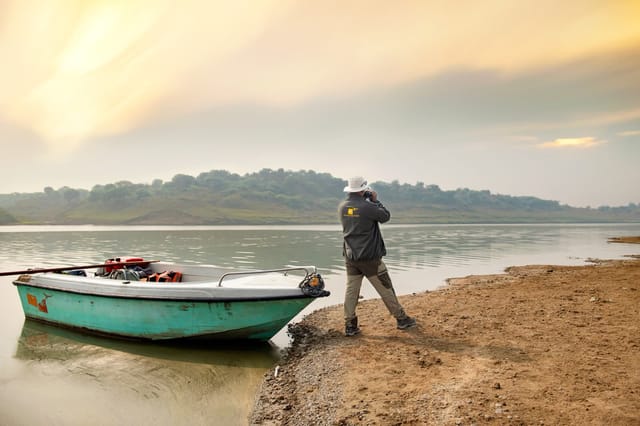
There is no jeep drive through a core zone here and no permit lottery at eleven in the morning. You go out on the water in a flat boat and look at the banks.

Uttar Pradesh names the freshwater dolphin and the gharial as the sanctuary's flagship species, alongside mugger crocodile, smooth-coated otters and eight species of turtle including the red-crowned roof turtle.

The birds are the other half of it. Two hundred and ninety species of resident and migratory bird have been recorded here. Flamingo arrive in November and stay until May. Ruddy shelduck get in earlier, in September, and also stay until May. Indian skimmers hold large colonies on the sand and breed here in numbers, which is not true of many rivers left in India.

An hour from the Taj

This is the fact that decides most trips. Mela Kothi, The Chambal Safari Lodge is at Village Jarar, near Bah in Agra district, and its own distance table puts the Taj Mahal at 64 km and one hour away. The lodge is fourteen rooms and cottages in regrown woodland on a family estate, with resident naturalists and a printed checklist of the 200-odd species found on the grounds. Our two-night trip is built here.

The river itself is a little further. The lodge gives the access point for the sanctuary as 22 km away, a drive of just over thirty minutes.

That geography is the argument for Chambal. Agra is a one-night city for most people, and a crowded one. An hour east of it there is a river with crocodiles on the sand and almost nobody on the bank.

Why everything here is priced per person

At a tiger reserve you buy a jeep. One permit covers up to six people, so a couple pays the same as a family of six, and filling the vehicle is how you make it cheap.

Chambal does not work like that. A boat is not a fixed six-seat unit, the sanctuary entry is charged by the head, and a naturalist goes out with you. So the costing is per person all the way down, and a party of two pays half what a party of four pays rather than the same.

Across our own rate cards here, a river safari that includes sanctuary entry and a naturalist runs at about Rs 5,000 a person. The two land drives are priced the same way and at about the same level: a jeep safari to the Sarus crane wetlands, and a blackbuck safari into the ravines. The shorter cultural excursions, to Bateshwar, to the heritage village at Holipura, to Rapri, to Ater Fort and around colonial Etawah, sit at roughly half that per person, and the confluence trip to Bhareh between the two.

So budget Chambal per head and per activity, and expect no group rate for filling a vehicle. A couple doing one river safari and one land drive is the normal shape of a two-night stay.

The two land safaris are not filler

The Sarus crane drive is the serious one. The Sarus Crane Conservation Reserve begins about 30 km from the lodge and runs on for roughly 100 km of wetland broken up by cultivation. It is not a protected area in the legal sense; the Supreme Court designated it a reserve in 1999 and restricted development on it. It holds the largest breeding congregation of Sarus cranes in India. The drive takes four to five hours, involves walking, and suits people who actually want the birds.

The blackbuck drive runs about 30 km south-west towards the ravines, takes three to four hours, and crosses farmland at the lip of the badlands. Indian courser is one of the things to look for.

What the state does not publish

Uttar Pradesh sells online safari permits for Dudhwa, Kishanpur, Katarniaghat, Pilibhit and Sohagi Barwa. It does not sell Chambal boat rides, and no Uttar Pradesh Forest Department or state ecotourism page we can find publishes an entry fee, a boat charge or a shift timing for the National Chambal Sanctuary. We are not going to invent them. The boat and the sanctuary entry are arranged on the ground through a lodge.

The state's general conduct rules for protected areas do apply. An authorised guide is compulsory, nobody leaves the vehicle except at authorised places, no arms or intoxicants go in, and no music is played.

When it is open

Uttar Pradesh gives the visiting season as 15 November to 15 June and names winter as the best time to be on the water, when the crocodiles haul out on the sand in the morning sun. The bird calendar argues the same way. Flamingo are there from November to May and skimmers breed in the dry months before the river rises.

Getting there

The official distances disagree, because the sanctuary is 180 km long in this state and the two departments measure to different points on it. Uttar Pradesh Ecotourism gives Agra as 70 km by road and Delhi as 270 km by the Yamuna Expressway. The Uttar Pradesh Eco-Tourism Development Board gives Kheria airport at Agra as about 107 km and Agra Cantt station as about 104.5 km, with access on NH 45 and the Agra-Yamuna Expressway.

For the lodge itself, use its own figures. Agra and the Taj Mahal are 64 km and an hour. Delhi airport is 300 km and five hours. Etawah is the nearest useful railhead at 50 km and about an hour, and Agra Cantt is 65 km and about ninety minutes. Bharatpur is 130 km and Gwalior 120 km. Coming from Agra the transfer is short enough that an afternoon arrival still leaves you a morning on the river.
The bougainvillea gateway of Mela Kothi, the Chambal Safari Lodge
The Chambal · Heritage safari lodge

Mela Kothi, The Chambal Safari Lodge

An hour from the Taj: a family seat traced to 1472, fourteen rooms in regrown forest, and slow boats past wild gharials on a river that bandit legend and an ancient curse kept blissfully undisturbed.

Rates on request, usually back within the hour

Ask on WhatsApp

All 16 stays in Uttar Pradesh

Common questions

What is the National Chambal Sanctuary?
The National Chambal Sanctuary, also called the National Chambal Gharial Wildlife Sanctuary, is a river sanctuary of roughly 5,400 square kilometres running along a 400 km stretch of the Chambal and the ravines one to six kilometres deep on either bank. It is administered jointly by Madhya Pradesh, Rajasthan and Uttar Pradesh. The Uttar Pradesh share is 635 square kilometres across the Agra and Etawah districts and covers about 180 km of the river. It was first notified in Madhya Pradesh in 1978 and given sanctuary status in 1979 to rebuild a gharial population that poaching had almost wiped out.
How far is the Chambal sanctuary from Agra and the Taj Mahal?
About an hour. Mela Kothi, The Chambal Safari Lodge at Village Jarar near Bah gives the Taj Mahal as 64 km and one hour from its gate, with the river access point a further 22 km and just over thirty minutes from the lodge. The official distances vary because the sanctuary runs 180 km through Uttar Pradesh: Uttar Pradesh Ecotourism gives Agra as 70 km by road and Delhi as 270 km via the Yamuna Expressway, while the Uttar Pradesh Eco-Tourism Development Board gives Agra Cantt station as about 104.5 km and Kheria airport at Agra as about 107 km.
Is a Chambal safari a boat or a jeep?
A boat. The National Chambal Sanctuary protects a river, so the main activity is a river safari in a flat boat looking at the banks and sandbars for gharial, mugger crocodile and Ganges river dolphin. There are two land drives as well, run from the lodges rather than through a forest gate: a jeep safari to the Sarus crane wetlands, and a blackbuck safari into the ravines. Neither of them is a core-zone tiger drive and there is no permit lottery to win.
What wildlife can you see on the Chambal river?
Uttar Pradesh names the gharial and the freshwater Ganges dolphin as the sanctuary's flagship species, alongside mugger crocodile, smooth-coated otters and eight species of turtle including the red-crowned roof turtle. Two hundred and ninety species of resident and migratory bird have been recorded in the sanctuary. Flamingo arrive in November and stay until May, ruddy shelduck arrive in September and also stay until May, and Indian skimmers hold large colonies and breed here in numbers.
How much does a Chambal river safari cost?
Uttar Pradesh does not publish an entry fee or a boat charge for the National Chambal Sanctuary on any of its forest department or ecotourism pages, and it does not sell Chambal boat rides through its online permit portal the way it does for Dudhwa or Pilibhit. In practice the boat and the sanctuary entry are arranged on the ground through a lodge. Across our own rate cards here, a river safari including sanctuary entry and a naturalist runs at about Rs 5,000 per person, and the Sarus crane and blackbuck jeep safaris are priced at roughly the same level.
Why is Chambal priced per person and not per jeep?
At a tiger reserve you buy a vehicle: one permit covers up to six people, so a couple pays the same as a family of six. Chambal is costed the other way round. A boat is not a fixed six-seat unit, sanctuary entry is charged per head, and a naturalist goes out with you, so every activity is priced per person. A party of two pays half what a party of four pays, and filling a vehicle earns no group rate. Budget Chambal per head and per activity.
When is the best time to visit the National Chambal Sanctuary?
Uttar Pradesh gives the visiting season as 15 November to 15 June and names winter as the best time, when the crocodiles haul out on the sandbanks in the morning sun. The bird calendar agrees: flamingo are present from November to May, ruddy shelduck from September to May, and Indian skimmers breed in the dry months before the river rises.
What else is there to do around the Chambal besides the river?
The Sarus crane jeep safari is the serious one for birdwatchers. The Sarus Crane Conservation Reserve starts about 30 km from Mela Kothi and extends roughly 100 km of wetland broken up by cultivation, and it holds the largest breeding congregation of Sarus cranes in India; the Supreme Court designated it a reserve with development restrictions in 1999. That drive takes four to five hours and involves walking. The blackbuck safari runs about 30 km south-west towards the ravines and takes three to four hours. Shorter excursions go to Bateshwar, the heritage village at Holipura, Rapri, Ater Fort, colonial Etawah and the Bhareh confluence, and there are guided nature walks and night walks on the lodge grounds.
Plan a trip · trusted local expert

The whole Chambal trip,
planned for you

Not just the room: drivers, trains, guides, the lot. Tell us the shape of the trip and Indiaesque builds it to your budget with our own people on the ground. No call centres, no mark-up mystery.

  • · A real itinerary from someone who lives there
  • · One WhatsApp conversation, from first idea to final itinerary
  • · Built and booked with Indiaesque — one clear price, taxes in
How many going?
The stay is a given — what else should we sort?

A real person replies on WhatsApp — no account, no password.

Deal alerts · free on WhatsApp

Never overpay
for ordinary

One tap on WhatsApp and you're on the list. Every new find reaches you before it reaches the site. Never spam, leave anytime.

Message us on WhatsApp

Opens WhatsApp — send the ready-made message, tap Join in our reply, done.

or we can message you

Free forever. We'll confirm on WhatsApp and send our best finds there — leave anytime.