Gir is the only place in the world with wild Asiatic lions. Gujarat notified it as a sanctuary on 18 September 1965, and the protected area now runs to 1,412.1 sq km, of which 258.7 sq km is national park and 1,153.4 sq km is sanctuary. Another 470.5 sq km of reserved, protected and unclassified forest sits around it as buffer, making 1,883.6 sq km of Gir forest across the Junagadh, Gir Somnath and Amreli districts of Saurashtra. The Forest Department's 16th lion population estimation, carried out in May 2025, counted 891 lions in Gujarat. Of those, 384 were in Gir National Park and Gir Wildlife Sanctuary and the ground next to it.
There are no zones here
Most Indian reserves sell you a permit for a named zone. Gir does not. The Forest Department states that the sanctuary and national park are not divided into zones and that there is no defined tourism zone. Drives run on designated routes of the Gir Jungle Trail, and your route is given to you at the reception centre at reporting time, worked out from your permit number. Nobody chooses it, and no lodge can choose it for you.
The gate, and who sits by it
Everything starts at Sasan. The reception centre is at Sinh Sadan, Sasan, and that is where permits are issued, guides are allotted and gypsies are hired. Sasan is 65 km from Junagadh and 45 km from Veraval.
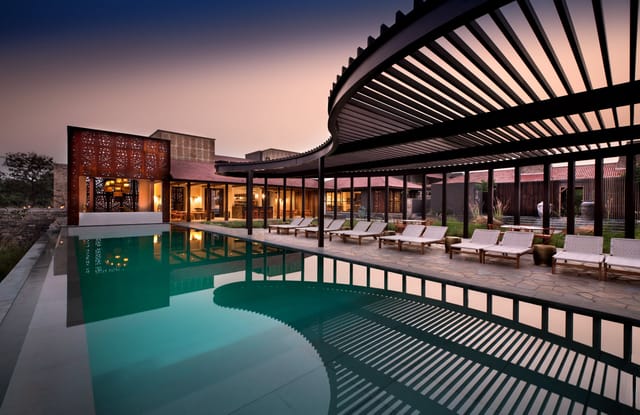
Aramness is at Haripur village, Bhalchel, in Junagadh district, on the edge of the park. Eighteen double-storey kothis line a cobbled village street, each with a courtyard and a first-floor veranda facing the teak.
How many permits exist
Three slots run each day. The Forest Department publishes 50 permits per slot on normal days and 60 on festival days and the second and fourth Saturday and Sunday. That is 150 permits a day for the whole reserve, or 180 at the busier rate.
One person can hold only one permit per slot per day. Bulk booking is not provided, and the department says the system is for eco-tourists rather than professional tour operators. The consequence matters more than it sounds: the permit is issued in your names, every visitor's name and identity card number goes on it at the time of booking, and foreign nationals must carry the passport itself. No one who is not named on the permit rides in the vehicle.
What a safari costs, broken down
One permit covers up to six people, plus one child aged 3 to 12. For Indian nationals it is Rs 800 Monday to Friday and Rs 1,000 on Saturday, Sunday and festival days. The extra child is Rs 100 or Rs 125.
For foreign nationals the portal contradicts itself. The terms and conditions give Rs 6,400 on weekdays and Rs 8,000 at the weekend and on festival days. The portal's own Gir page gives Rs 7,600 and Rs 9,500 for the same two things. Two official pages, two answers. Read the figure on the booking screen before you pay.
A registered guide is compulsory, costs Rs 400 for the trip, is paid directly to the guide and is allotted by the department rather than picked. The gypsy is hired locally at Sasan and is not in the permit. The services page quotes Rs 2,000. The terms price it by vehicle type instead: Rs 2,000 for an older six-seater, Rs 3,500 for a new six-seater, Rs 4,500 for an eight-seater. A camera costs Rs 200 for Indian nationals, and for foreign nationals it is 20 times the current dollar rate.
So an Indian party on a weekday, in the cheapest vehicle, pays Rs 3,200 for permit, guide and gypsy.
A lodge here cannot hold a permit for you the way a lodge in Madhya Pradesh can, because the names on it have to be yours. What it can do is book the moment the window opens, put its own naturalist in the vehicle alongside the forest guide, and have you at Sinh Sadan half an hour before the slot.
Devalia is not a Gir safari
This is the thing people get wrong. Devalia is the Gir Interpretation Zone, a fenced 412 hectares with a double-gate entry, about 13 km from Sasan village. Lions, leopard, spotted deer, blue bull, blackbuck, chinkara, sambar, jackal and vultures live inside the fence in natural habitat. It has three safari routes. Forest Department mini buses run from the Devalia reception centre, and gypsies run from Sinh Sadan. It is closed every Wednesday.
The permit for a Devalia gypsy is the same Rs 800 and Rs 1,000 for Indian nationals. The bus is Rs 150 on weekdays and Rs 190 at the weekend.
What makes it worth knowing is the calendar. On 21 September 2026 the portal was selling Devalia permits while every Gir Jungle Safari date showed closed. In the monsoon, Devalia is the lion you can actually go and see.
When it is open
Gir Jungle Safari runs from 16 October to 15 June and is closed from 16 June to 15 October every year. The live booking calendar agrees: the first bookable date of the 2026 to 2027 season is 16 October 2026, and 16 to 25 October 2026 carry the festival rate, so an October arrival pays the higher of the two permit prices.
Timings, from the portal's terms: winter, from 16 October to the end of February, 6:45 to 9:45, 8:30 to 11:30, and 15:00 to 18:00. Summer, 1 March to 15 June, 6:00 to 9:00 and 16:00 to 19:00. The portal's own Gir page prints 6:30 to 9:30 and 9:00 to 12:00 for the winter mornings, so go by the time printed on your permit.
Booking opens three months before the date of visit according to the terms, and a maximum of 45 days in advance according to the FAQ on the same site. Try at three months. Report at the reception centre 30 minutes before the slot, because late reporting voids the permit.
Getting there
Keshod is the nearest airport at 60 km, then Diu at 100 km, Rajkot at 160 km and Ahmedabad at 370 km. Sasan has its own station on the Western Railway, with Veraval 45 km away and Junagadh 60 km. Taxis and buses run to Sasan from both Junagadh and Veraval. Every one of those is a road transfer at the end of a flight, so the day you arrive is a travelling day and not a safari day.