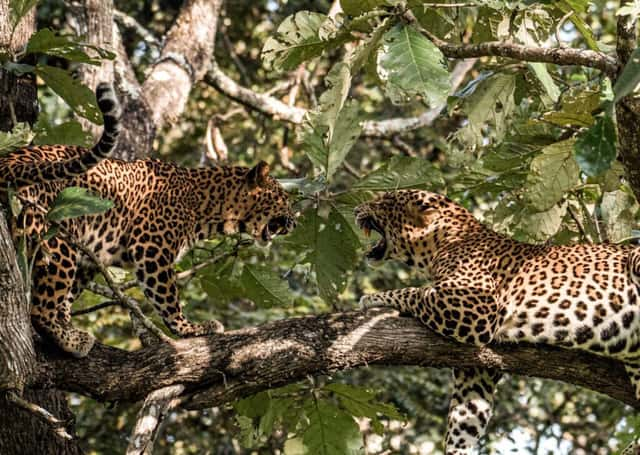
Kabini is the southern side of Nagarahole Tiger Reserve, on the backwaters of the Kabini river in Karnataka. The reserve spans the Mysuru and Kodagu districts and totals 1,205.76 square kilometres: a core of 643.35 square kilometres, 200.57 square kilometres of forest buffer and 361.84 square kilometres of non forest buffer. It takes its name from the Nagarahole, a small river that winds through the forest before joining the Kabini. Bandipur Tiger Reserve adjoins it to the south east and the Wayanad Wildlife Sanctuary of Kerala to the south west, and the whole of it sits inside the Nilgiri Biosphere Reserve. Tiger density is high for India at around 12 to the hundred square kilometres.
The thing to understand before you book is that Karnataka does not sell a safari the way Madhya Pradesh and Maharashtra do.
Seats, not vehicles
At Kanha or Tadoba a permit buys a whole jeep and you fill it with your own party. At Nagarahole the forest department's ticket portal prices the safari by the head.
A jeep safari is Rs 1,500 for anyone over twelve and Rs 750 for a child of three to twelve. A bus safari is Rs 1,000 and Rs 500. A camera with a lens above 200mm is Rs 1,770 including GST.
The portal publishes one tariff. It sets out no separate foreign national rate, though it does require foreign visitors to produce a passport as identity proof.
So unless a lodge takes a whole vehicle for you, you are sharing it with whoever else bought seats on that round.
The gates
The reserve has three safari gates and only one of them is Kabini.
Kakanakote is the Kabini gate, in the Antharasanthe range of HD Kote taluk. The portal gives it as 61 km from Mysuru, 25 km from HD Kote and 115 km from Madikeri, reached by way of HD Kote Handpost and the Bavali road. It is the only gate currently selling safaris online.
Veeranahosahally, on the Hunsur side, is 65 km from Mysuru and 70 km from Madikeri. Nanachi, on the Kutta and Coorg side, is 95 km from Mysuru and 85 km from Madikeri. Online booking is shut at both, and tickets are sold at the gate counter only.
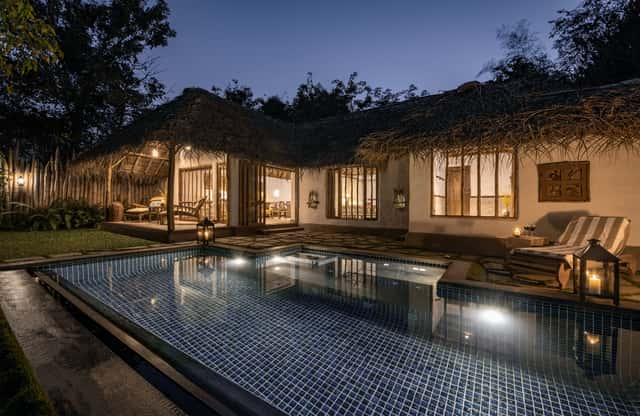
KAAV Safari Lodge is our one property here, ten rooms on the fringe of Nagarahole with signature rooms, tents and a pool villa. Safaris, treks and river kayaking go out from it.
The boat, which is why people come
Kabini is one of very few places in India where a safari is made on water. Karnataka Tourism describes sailing the backwaters of the Kabini by motorboat through the forest, twice a day, for about two to two and a half hours.
The boats come from the lodges rather than from the forest counter. Nagarahole's ticket portal lists two things at Kakanakote, a jeep and a bus, and the boat is not one of them. Jungle Lodges and Resorts, the Government of Karnataka's own lodge company, runs motorboats and traditional coracles made of bamboo and buffalo hide from its lodge at Karapura. If you want a boat safari at Kabini you arrange it through a lodge, not through the portal.
What a safari costs, broken down
An official jeep seat at Kakanakote is Rs 1,500 a person. A drive arranged by a lodge here runs roughly Rs 3,000 to Rs 4,500 a person on our own rate cards, and it too is priced per person rather than per vehicle. The cheaper end of that range is a combined bus and boat outing. The jeep is the dearer one. Foreign nationals are charged about Rs 500 more a drive by the lodge, even though the forest portal publishes a single rate for everybody.
That leaves a gap of roughly Rs 2,000 to Rs 2,500 a person, and it is worth knowing what it buys.
It buys the seat, which is the hard part. Online booking at Kakanakote opens only 15 days before the date and closes 48 hours before it, so there is no booking a season ahead and no long planning window. It buys the run to the gate and back. It buys a lodge naturalist in the vehicle with you. It is also the only way to get on a boat.
Camera charges are close to a pass through. The lodge figure on our cards, about Rs 1,800 for a lens over 200mm, sits within Rs 30 of the forest department's own Rs 1,770.
The rules and the hours
Safaris at Kakanakote run 06:30 to 09:30 in the morning and 15:00 to 18:00 in the evening, three hours each. That is an hour longer than the two hour rounds at Nanachi.
Report at the safari point 30 minutes before.
Carry the original photo ID you booked with. Foreign visitors must produce a passport. You have to register on the portal before you can book anything, and registration is verified by an OTP to a working mobile number.
Neither the reserve's ticket portal nor the state tourism board publishes a weekly closed day for Nagarahole, or an annual closed season for Kabini. Tadoba shuts its core every Tuesday and right through the monsoon. Kabini does neither, so far as the official sources say. Individual ranges do close at short notice, so check the portal before you travel.
When to go
Karnataka Tourism and the state lodge company both point at March, April and May. The pools inside the forest dry up and the animals come down to the Kabini to drink. Karnataka Tourism calls what gathers on those banks the largest herd of Asiatic elephants in the world. July to September is the monsoon, green and thick, with fewer sightings. The winter months are cooler and give a fair chance of both animals and birds.
Getting there
Mysuru is the nearest city to the Kabini gate at 61 km, and the run is Mysuru, HD Kote Handpost, the Bavali road, Kakanakote. Madikeri is 115 km. Both are road transfers of some hours, so the day you arrive is a travelling day and not a safari day.