21 July 2026
Ahilya Fort, the philosopher-queen's house on the Narmada
The 18th-century queen Ahilyabai Holkar ruled Malwa from this fort above the Narmada. Her descendants still live in it, and since 2000 take guests.
The 18th-century queen Ahilyabai Holkar ruled Malwa from this fort above the Narmada. Her descendants still live in it, and since 2000 take guests.
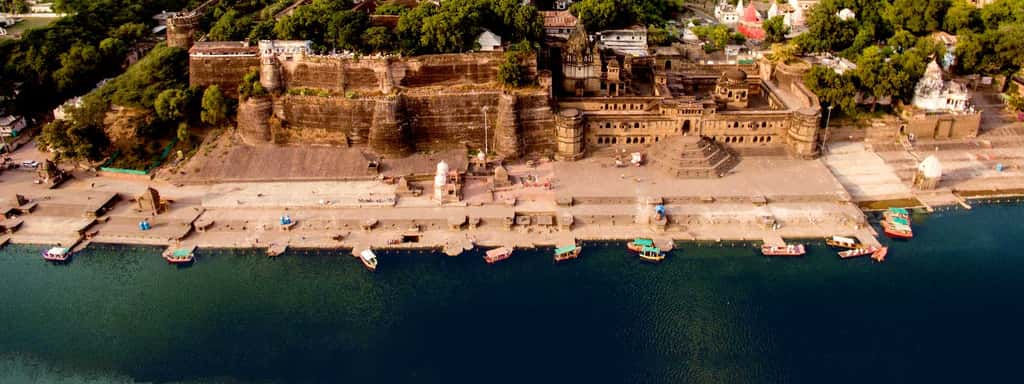
High above the Narmada, some ninety kilometres from Indore in a town most travellers have never heard of, is one of the more unusual places you can spend a night in India: a working family fort, still lived in by the descendants of the woman who built it.
It is worth knowing who she was before you arrive. Ahilyabai Holkar was born in 1725 and took over the Holkar kingdom of Malwa in 1767, after the deaths of her husband and her father-in-law, and ruled it for twenty-eight years. She made this small Narmada town, Maheshwar, her capital, and what she did from here was extraordinary. She rebuilt the Kashi Vishwanath temple at Varanasi, restored Somnath, raised the Vishnupad temple at Gaya, and laid ghats, wells, rest-houses and schools across the whole of India: a building programme run by a queen, from a riverbank in Malwa. The historian John Keay called her the philosopher-queen of Malwa; Nehru wrote that her reign "has become almost legendary as a period during which perfect order and good government prevailed." She championed the town's women weavers, too, Maheshwar is still one of India's great handloom centres, known the country over for the Maheshwari saree.
Her fort, Ahilya Wada, is the one you stay in, and it never left the family. In 2000, Prince Richard Holkar, a direct descendant, and son of the last Maharaja of Indore, opened the family home to guests: nineteen rooms across six old buildings, set among three acres of courtyards, fountains and gardens high above the river. It is emphatically not a hotel dressed as a palace. There is no reception-desk theatre, and no buffet. Dinner is a fixed daily menu, designed by Prince Richard and grown largely in the fort's own organic beds, eaten together at one long table. There is a pool in a walled garden, yoga on the ramparts at dawn, massages, and otherwise the considerable luxury of nothing much to do.
Because the fort stands directly above the river, the Narmada is the fourth wall of the place. Below run the ghats the queen built, and boats drift on the water beneath your window. Maheshwar is said to have more than a hundred temples, and the riverfront Kashi Vishwanath and Sahasrarjun shrines are a short walk from the gate. In the lanes, the Rehwa Society, founded in 1979 to revive the weaving, and counting, by its own telling, around a hundred and thirty weavers, is still at the looms.
You may have seen these walls before without quite knowing it; they have stood in for old India in films from Ashoka to Pad Man. But the reason to come is quieter than any of that. Ahilya Fort is one of the few places left where you sleep inside real, un-museumed history, a house still warm with the family whose ancestor built half the ghats in India, while the sacred river turns to gold beneath the window.
Indore is the gateway: the fort sits some ninety kilometres south, call it two hours by road, and Indore's airport, named, fittingly, for Devi Ahilya Bai Holkar, connects across India. The fort stands above the ghats, so steps are part of the address; if stairs are a concern for anyone in your party, say so and we'll plan around them.
Rooms, rates and the enquiry form are on the Ahilya Fort stay page, tell us your dates and we'll do the arranging.
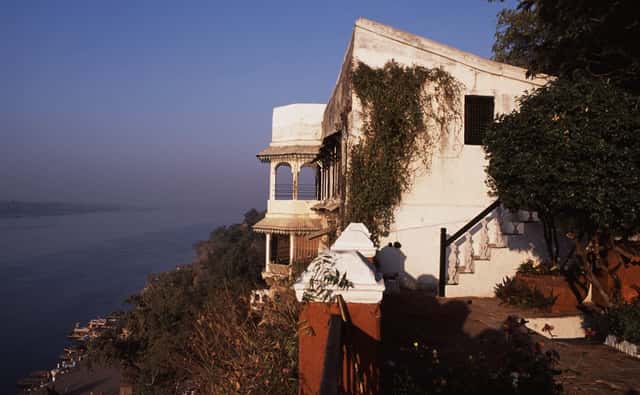
High above the ghats of the sacred Narmada, in the weaving town of Maheshwar, stands the 18th-century fort-palace of Ahilyabai Holkar, still in the family, and now opening its courtyards to a handful of guests. Nineteen rooms across six old buildings, three walled courtyards, a garden pool, and a daily table grown in the fort's own beds. One of central India's great stays.
Rates on request, usually back within the hour
Ask on WhatsAppStays featured in the Journal are part of the Indiaesque collection. All information believed correct as of 30 August 2026. Errors and omissions excepted.
You're in. 🎉 New finds land on your WhatsApp before they land here, and a real person is one message away.
One tap on WhatsApp and you're on the list. Every new find reaches you before it reaches the site. Never spam, leave anytime.
Message us on WhatsAppOpens WhatsApp — send the ready-made message, tap Join in our reply, done.
You're on the list the moment you're done. Done it? Continue →
Nothing arrived? Send us a quick “hi” instead — that works every time. Message us on WhatsApp →
Free forever. We'll confirm on WhatsApp and send our best finds there — leave anytime.
One tap on WhatsApp. No password, no card, leave anytime. Every new find and every deal lands with you first.
Message us on WhatsAppOpens WhatsApp — send the ready-made message, tap Join in our reply, done.
You're on the list the moment you're done. Done it? Continue →
Nothing arrived? Send us a quick “hi” instead — that works every time. Message us on WhatsApp →
Your booking is handled personally by the Indiaesque team, start to finish — no call centre, no middlemen.
We use cookies to measure how the site is used and how well our ads work. That includes cookies set by PostHog, Microsoft Clarity, Meta and Google. How we use them.