Keoladeo National Park covers 28.73 square kilometres in Bharatpur district, Rajasthan, which makes it one of the smallest national parks in India and the reason you can walk a good deal of it. It was notified on 27 August 1981, and Rajasthan Tourism gives 1982 as the year it was declared a national park; UNESCO listed it as a World Heritage Site in 1985. Most people still call it Bharatpur, or Ghana. It is a bird park, and it is entered on foot.
There are no jeep safaris here
Keoladeo has no zones, no Gypsies and no Canters. The park has well-defined tracks, and you cover them on foot, by bicycle or by cycle-rickshaw. The rickshaw is the thing that makes this place work: the park management has trained the rickshaw pullers in bird watching, and Rajasthan Tourism describes them as extremely knowledgeable guides. You are not being pedalled about by a man waiting for the fare. You are being taken to birds by somebody who knows where they are standing this week.
That is why Keoladeo rewards slowness in a way a tiger reserve cannot. Nothing is chasing a sighting. You stop where you want to stop.
What it is, and where the water comes from
The wetland is man-made. It began in the mid-18th century as a small reservoir 5 km southeast of Bharatpur, and the building of the Ajan Bund flooded a natural depression. From the 1850s it was a royal hunting reserve and then a shoot for the British: Lord Linlithgow, Viceroy from 1936 to 1943, is recorded as having shot over a thousand ducks with his party in a single day. The ornithologist Salim Ali then used his standing to get government backing for the park.
Rajasthan Tourism counts over 370 species of birds here and the state booking portal says over 350; either way it is among the richest bird areas in the world. Green sandpiper and cranes arrive in thousands each winter. Painted storks nest, pythons bask, and nilgai and deer use the same tracks you do. This was the wintering ground of the Siberian crane, the bird the place is most associated with and the one you should not expect to see.
What it costs
The state's official booking portal publishes Keoladeo's charges in full, which is more than most Rajasthan parks do. Entry is Rs 130 for an Indian visitor and Rs 830 for a non-Indian visitor. Students pay Rs 50. Children under five go in free. A still camera is free. A video camera is Rs 890 for an Indian visitor and Rs 1,320 for a non-Indian.
That is the whole government bill. No vehicle charge, no compulsory guide fee, no permit to chase months ahead. A rickshaw and its puller are hired at the gate on the day. Set against a Rajasthan tiger reserve, where the jeep and the guide dwarf the entry fee, Keoladeo is the cheapest serious wildlife day in the state by a distance.
When it is open
The permit is a full day ticket, and the park's published hours are 06:00 to 17:00. There is no weekly closed day published. Bookings are handled as either a group booking, made in the name of an institution with a group leader, or an individual booking, and the booking form has a private vehicle option if you are bringing one in.
The birds set the season rather than the gate does. The migratory waterfowl are a winter arrival, so November to February is when the park does what it is famous for. Come in June and you have a wetland with a fraction of its birds.
Getting there
Bharatpur railway station is about 5 km from the park, and trains connect it to Delhi, Mumbai, Jaipur and Agra. The nearest airport is Agra at 56 km. Delhi is 184 km, Jaipur 185 km, Alwar 100 km and Ajmer 318 km. Fatehpur Sikri is close enough to the southeast to pair with a morning here.
Where we put you, honestly
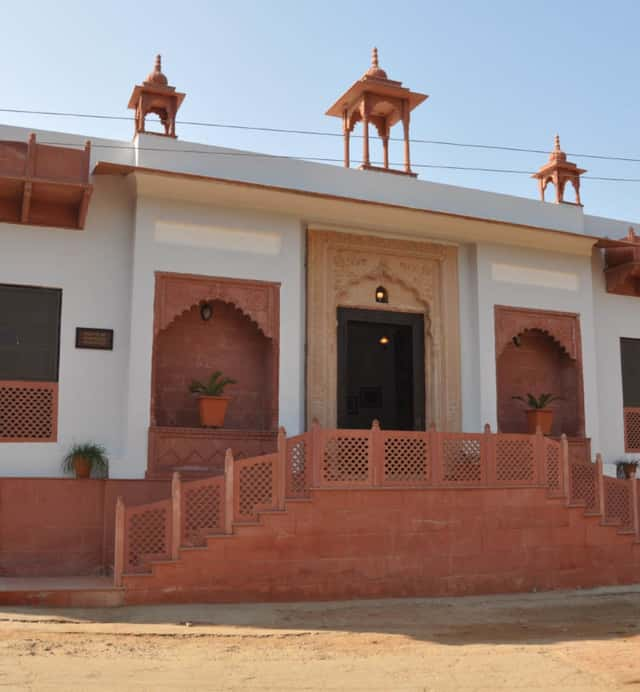
We hold one property here and it is not at the gate. Chandra Mahal Haveli is an 1840 haveli in the village of Pahersar on the Jaipur to Agra road, about 23 km from Bharatpur, with ten heritage rooms and four terrace suites around the original courtyards and a courtyard pool.
Twenty-three kilometres is roughly forty minutes each way, and the park opens at six. If your priority is being through the gate at first light every morning, a bed nearer the entrance will serve you better and we would rather say so. If you want a building worth sitting in for the middle of the day, and one full early start rather than three rushed ones, the haveli earns its distance. Either way the day you arrive is a travelling day.