Corbett Tiger Reserve covers 1,288.31 square kilometres in the Nainital district of Uttarakhand, 821 of them core-critical habitat and the rest buffer. It runs from about 1,300 to 4,000 feet, through sal forest, the grassland the reserve calls chaur, and riverine scrub along the Ramganga. It opened in 1936 as Hailey National Park at 323.75 square kilometres, was renamed for Jim Corbett in 1956, and Project Tiger was launched here on 1 April 1973. There are eight tourism zones, and which one you book changes the trip more than at any other Indian reserve.
The gates, and who sits by them
Dhela gate is the one to know, because it serves two zones, Dhela and Jhirna, and those two are the only zones open all year. The reserve puts Dhela gate at about 20 km from Ramnagar.
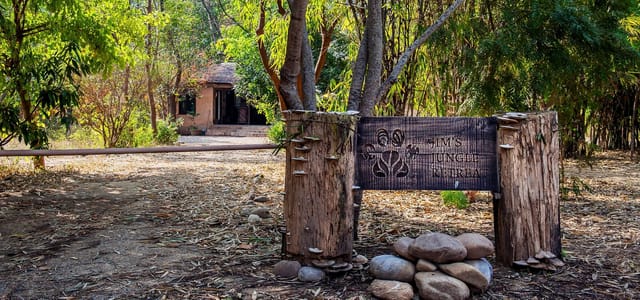
Jim's Jungle Retreat is at village Dhela. Its own account starts in the 1990s with a search for land that was not part of an animal corridor, pockets bought at Dhela, and the first tree planted in 2002. Today that is eighteen cottages in more than fifteen acres of replanted forest, with bird walks and a village walk at Dhela alongside the drives.
Amdanda gate opens Bijrani, roughly 15 to 20 km from Ramnagar. Dhangari gate opens Dhikala. Durgadevi gate opens the hill zone of the same name on the north-eastern side. Garjiya gate opens Garjia, though the reserve's own safari page calls that gate Ringora. Vatanvasa opens Sonanadi and Pakhro opens Pakhro, and for both the nearest town is Kotdwar rather than Ramnagar.
Dhikala is not a day trip
Dhikala sells no day jeep permits at all, and that is the fact that catches most first-time visitors. There are two ways in.
The canter is a 16-seater open bus on a fixed route, boarding at the Ramnagar office or Dhangari gate. Seats are sold individually, at Rs 1,500 plus 18 per cent GST for Indian nationals and Rs 3,000 plus 18 per cent GST for foreign nationals, and no more than four can be booked at once.
The other way is a night inside. Dhikala Forest Rest House sits at the edge of the Patli Dun valley above the Ramganga, the old building dating from the 1890s, and it was where Project Tiger was launched. It opened to tourists after 1975. There is a restaurant, a canteen, a library, evening wildlife films and a post office. A night-stay booking carries two jeep safaris in it. No alcohol and no non-vegetarian food are allowed, and nothing moves by vehicle after dark.
What a safari costs, broken down
The reserve publishes its charges, and they are per vehicle rather than per head.
A day permit is Rs 3,380 for Indian nationals and Rs 6,680 for foreign nationals, and that figure covers the party whether one person travels or six. It takes in the safari fee, the vehicle permit fee, solid waste management and the portal fee. A guide is Rs 1,000. The gypsy is charged by zone: Rs 2,700 at Amdanda for Bijrani, Rs 3,000 at Dhela, Garjiya and Durgadevi, Rs 2,800 at Pakhro, and Rs 2,800 to Rs 4,500 at Vatanvasa for Sonanadi.
So a morning in Bijrani for a jeep of six Indian nationals is Rs 7,080, and the same jeep of six foreign nationals is Rs 10,380. Indian senior citizens take Rs 250 off per person and Indian students aged 12 to 18 take Rs 375 off per person, both against ID.
A night stay is priced per room for two: Rs 3,500 to Rs 5,050 for Indian nationals, Rs 10,450 for foreign nationals, plus vehicle and driver at Rs 5,750 to Rs 7,750 depending on the zone, plus the Rs 1,000 guide. Two safaris are already inside that.
Only Jhirna publishes a vehicle cap: 30 jeeps a shift, two shifts a day. No other zone's quota is posted.
The rules that catch people out
Mobile phones may not be used inside the tourism zones of the core habitat. The reserve carries this on its home page as compliance with an order of the Supreme Court of India.
Six people to a permit, including up to two children under 12, and children under 12 need no permit of their own. If one foreign national is on the permit, every passenger is charged the foreign rate. OCI card holders and SAARC nationals pay Indian rates.
Private vehicles cannot enter for tourism. A gypsy is allocated to you automatically when you book, and you have eight hours after booking to change it. Online ticketing runs from 5:30am to 11:30pm, but on the day of the visit the last moment to book online is 6:30am for the morning session and 4:00pm for the afternoon.
The reserve is a zero plastic zone with a Rs 500 spot fine for littering or spitting.
The reserve states that corbettgov.org is its only official website and publishes a list of nineteen unauthorised sites and addresses using its name. Check the domain before you pay anybody.
When it is open
Jhirna and Dhela are open throughout the year. Bijrani runs 15 October to 30 June. Dhikala, Durgadevi, Sonanadi and Pakhro run 15 November to 15 June on the pricing table.
The reserve's own pages disagree on the rest. The pricing table gives Garjia as 15 October to 30 June; the home-page table gives Garjia as open throughout the year. The zone pages for Durgadevi, Sonanadi and Pakhro all say 15 October, where the pricing table says 15 November. A September 2026 notice settles Garjia in practice: day-visit bookings for Dhela, Jhirna and Garjiya opened at 5:30am on 12 September 2026 for the period 15 to 27 October 2026, which is an October reopening, not a year-round zone.
The advance window is 45 days for jeep and canter. Night stays are messier. The home page says foreign-national stay bookings open 90 days ahead and that Indian bookings for the new season opened at 10:00am on 4 October 2026; the rest house page says Indians book Dhikala 46 days ahead and foreign nationals 91 days ahead. Check the portal for your dates before you buy flights.
Getting there
Ramnagar serves the Dhela, Amdanda, Dhangari, Durgadevi and Garjiya gates, with the railway station and bus stand. Pantnagar is the nearest airport, about 90 km from Bijrani. Kotdwar is the town for Vatanvasa and Pakhro, and Pakhro is two hours from Jolly Grant airport at Dehradun. Every route in is a road transfer, so the day you arrive is a travelling day rather than a safari day.