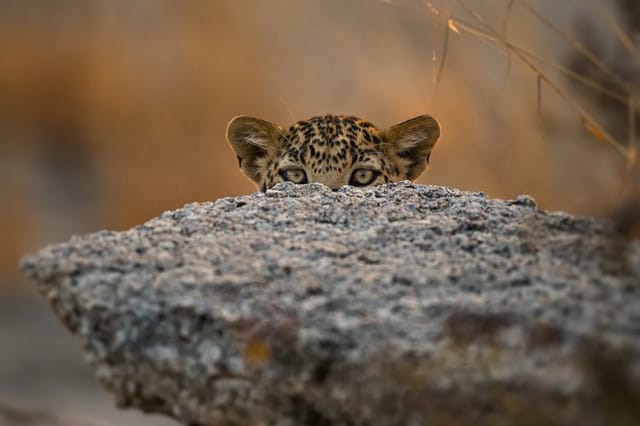
Jawai is leopard country in Pali district, Rajasthan, built around the Jawai Bandh dam and the granite hills that rise out of the farmland behind it. On the forest department's register it is not one protected area but two, and neither is a national park, a sanctuary or a tiger reserve. Jawaibandh Leopard Conservation Reserve covers 19.79 square kilometres and was notified on 27 February 2013. Jawai Bandh Leopard Conservation Reserve-II covers 61.98 square kilometres and was notified on 15 June 2018. Together that is about 82 square kilometres of conservation reserve, wrapped around and threaded through land that people farm and graze.
There is no permit, and that is the whole story
Rajasthan runs a state portal for wildlife permits. Ranthambhore, Sariska, Kumbhalgarh, Keoladeo, Jhalana, Mount Abu, Tal Chhapar and a dozen more are all on it, each with its zones, its shifts and its booking windows. Jawai is not on it, and is not on the state tourism board's wildlife booking list either.
That is not an oversight. A conservation reserve is a different category from a national park, and the leopard hills at Jawai sit on private and common land rather than inside a gated core. So there is no permit to buy, no zone to be allotted, no vehicle quota to beat and no on-sale date to set an alarm for. The camps run the drives themselves, on land they have access to, in their own vehicles, on their own timings.
Practically, this makes Jawai the easiest wildlife destination in Rajasthan to visit. No 90-day advance scramble. No gate closing at 8:30. No morning lost to a Wednesday. If a camp has a room, you can go out looking for leopards the evening you arrive.
The trade is that the camp is the product. There is no forest department fallback: what you see and how you see it is entirely down to who takes you out. That is an argument for choosing the camp carefully rather than the cheapest room near the dam.
Where we put you
SUJÁN JAWAI is the one we hold here. Ten tented suites among granite a billion years old, in country where leopards live openly alongside Rabari herdsmen and their flocks. Drives go out twice a day. There are Marwari horses, and brass baths lit by candle under the stars.
Our trip here is Three Nights in Leopard Country. Three nights is the right length at Jawai: leopards on these hills are resident rather than passing through, and a third morning is what turns a sighting into watching an animal behave.
A conservation contribution of Rs 7,500 a person applies at this camp. It is not a government levy and it is not a permit. It goes to the conservation work on the land you are driving over, which is the reason the leopards are still there.
The dam
Jawai Bandh was built across a tributary of the Luni by Maharaja Umaid Singh of Jodhpur and is believed to be the largest dam in western Rajasthan. Besides supplying water to the villages around it and to Jodhpur city, it holds crocodiles and draws migratory birds through the winter. The birds and the leopards share the same season, which is why the cool months are the ones to come in.
Getting there
Jawai sits in Pali district. Rajasthan Tourism gives Jodhpur as the district's nearest airport, 77 km from Pali town, and the district is reached by road on NH14 with regular trains from Jodhpur and Beawar. We have not found an official distance published from any airport or railhead to the dam itself, so ask the camp for the transfer time rather than working off a map.
Two things worth building into the same trip, both in Pali district: the Ranakpur Jain temples and the Parshuram Mahadev cave temple, cut into rock above 3,990 feet. Either fills the middle of a day between drives.