Sariska Tiger Reserve covers 1,213.34 square kilometres across the Alwar, Jaipur Rural and Kotputli-Behror districts of Rajasthan, in the Aravalli hills. Sariska Sanctuary, the older protected area inside it, accounts for 544.22 of those square kilometres in Alwar district alone. Two other official sources give smaller numbers for the reserve: the state booking portal says 881 square kilometres and Rajasthan Tourism says over 800. The forest department's own protected area register is the figure we use. Sariska was declared a sanctuary in 1955, became a national park in 1979, and is the first tiger reserve in the world to have relocated tigers into it successfully. Safaris run from two gates through five numbered zones.
The gates, and who sits by them
Sariska gate opens onto zones 1, 2 and 3. Zone 1 runs Sariska, Ghanka tirya, Tarunda, Brahmanath, Kalighati and Pandupol. Zone 2 goes by Bharthari tibara, Karnakabas, Jalebi chowk, Alguaal, Naya pani and Geru ka tirya before joining Kalighati and Pandupol. Zone 3 is the long one, out through Kalighati and Kabri gate to Kankwari and the Neelkanth Mahadev temples and back by Tehla.
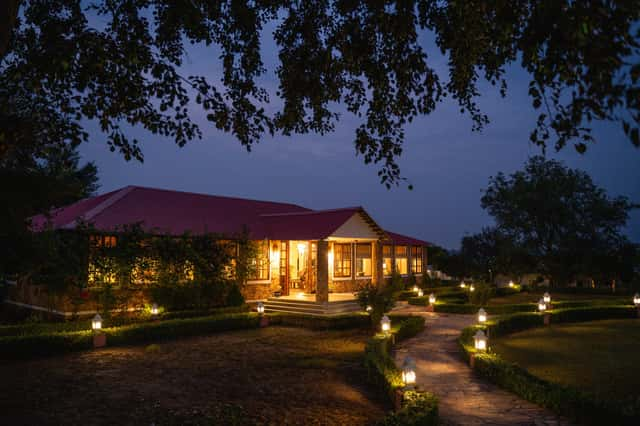
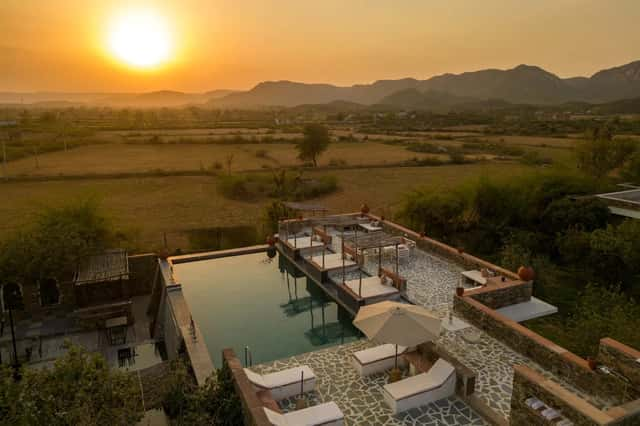
Sariska Safari Lodge sits on 6.5 acres at the periphery of the reserve, with nineteen cottages in five clusters finished in locally sourced materials. The first-floor Maharani Suite looks out to Thanagazi Fort.
Tehla gate is the second gate and opens onto zones 4 and 5. Zone 4 runs Chamari ka bera, Kalighati and Pandupole. Zone 5 goes by Kabri gate and Kankwari gate to Neelkanth Mahadev and Dabkan.
Utsav Camp Sariska is 7 km from Tehla gate, eighteen stone cabins, bungalows and duplex villas on seven hectares of boulder country replanted from bare scrub since 2009. Our Two Nights at Sariska trip is here.
What a safari costs, broken down
The state's booking portal publishes Sariska's advance booking charge, and it is the same at both gates. A Gypsy is Rs 1,152 for an Indian visitor and Rs 1,892 for a foreign one. A Canter is Rs 776 and Rs 1,516.
The portal does not label those figures per seat or per vehicle on its public page. Two things point to per seat. Ranthambhore's portal, run by the same department, states in writing that its advance bookings are processed per seat. And the Rajasthan booking procedure says you may book a Gypsy for six members at a time and twenty in a Canter, which is the language of filling seats. Read that way, an Indian party of six pays Rs 6,912 for the vehicle's permits, and a foreign party of six pays Rs 11,352.
A drive arranged for you sits above that. Our own rate card here is Rs 12,500 for a jeep of six Indian nationals and Rs 15,500 for six foreign nationals. The gap covers the vehicle, the guide and somebody holding a permit for a park that closes one day in seven.
Not everything at Sariska is a park safari. The same camp will take you out on its own land with its rangers, or birdwatching with a naturalist, or on the drive to Neelkanth, each at Rs 6,000 a vehicle for six, and on a wilderness walk at Rs 1,500 a person. Those need no forest permit at all.
The rule that catches people out
Wednesday is a weekly holiday for tourism and safari in Sariska Tiger Reserve. Both the state booking portal and Rajasthan Tourism say so, in those words. A two-night trip built across a Wednesday loses its park drives, and this is the single most expensive thing to get wrong here. Book around it, or spend the Wednesday on the camp's own drives and walks, which run anyway.
Neelkanth is about 30 km inside a buffer zone of the reserve, on rough road, and the Pandupol Hanuman temple sits by a waterfall further in. Kankwari Fort can only be reached on a jeep safari. None of these is a quick detour.
When it is open
Advance online bookings for visits from 1 October 2026 opened on 1 September 2026 at 2:00 PM, so the reserve sells its season from 1 October. We have not found an official closing date published for the core, and we are not going to invent one; check your dates on the state portal before you book flights. What is published is that the buffer stays open outside the core season, and that Wednesday closure applies throughout.
Getting there
Rajasthan Tourism puts Sariska 200 km from Delhi and 107 km from Jaipur. Both are long road transfers, so the day you arrive is a travelling day rather than a safari day. Alwar is the nearest town of size, and Siliserh lake, Bala Qila and the Bhangarh ruins are all within reach of it if you have a spare afternoon or a Wednesday to fill.