Similipal Tiger Reserve runs to 2,750 sq km in Mayurbhanj district, in the northernmost part of Odisha: 1,194.75 sq km of core, or critical tiger habitat, and 1,555.25 sq km of buffer. It is an inclined plateau of moist mixed deciduous forest and high-level sal above 850 metres, with grassland on hilltops over 900 metres, cut by the Budhabalanga and the headwaters of the Salandi and Baitarani. The reserve's own count is 55 mammals, 361 birds, 62 reptiles, 21 amphibians and 1,076 plant species including 94 orchids.
The reason to come is one sentence on the reserve's own website: the tigers of Similipal carry a unique lineage of central Indian tigers in which melanistic tigers are occasionally found, and it is the only home of these black tigers in the world. Nowhere else has them. Sightings of any tiger here are a matter of chance and the reserve says so plainly.
Two gates, and you drive in yourself
This is the part where Similipal differs from almost every other tiger reserve in India. You take your own vehicle in.
Entry is through Pithabata gate near Baripada and Kalikaprasad gate at Jashipur, which the reserve also calls Kaliani. Sixty four-wheelers a day are allowed in: 35 through Jashipur and 25 through Pithabata. The vehicle must have four-wheel drive and a ground clearance of 180 mm or more. Sedans and hatchbacks are refused at the gate, and heavy vehicles are not allowed at all.
A guide is mandatory for every vehicle. The permit is issued under Section 28 of the Wildlife (Protection) Act 1972 and the Wildlife (Protection) (Orissa) Rules 1974, and the vehicle registration and the driving licence have to be produced at the gate. Use one form per vehicle.
There is a small contradiction to know about. The reserve's Plan Your Visit page says a day entry pass can be bought online at similipal.org or offline at the gates. The Field Director's own public notice for the season says entry permits can be obtained through the website only. Book online and the question does not arise.
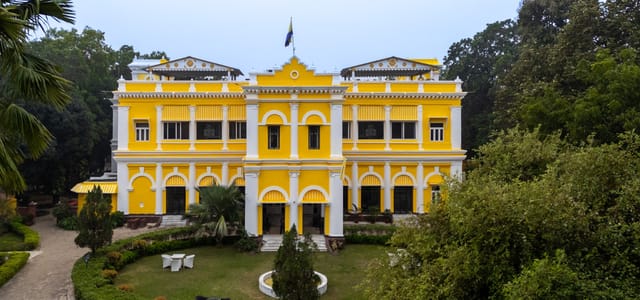
The Belgadia Palace is at Baripada, the Pithabata side, in a Victorian mansion of the 1800s on fifteen acres run by the 48th generation of the Bhanj family. The reserve puts Pithabata gate at about 20 km from Baripada.
What a safari costs, broken down
The reserve runs its own open safari vehicles and publishes the price: Rs 4,500 a safari, the same from every boarding point. There are three, and the fleet is small. Pithabata boards for the Nawana zone with seven vehicles, Gurguria for the Gurguria zone with seven, and Jamuani for the Chahala zone with four. Eighteen vehicles for 2,750 sq km.
Timings on the safari page are a morning run leaving at 5:30 am and finishing within five hours, and an evening run leaving at 3:00 pm and finishing within four. The reserve's own safari timing sheet gives a different pattern for the six-seater open Jimny safaris: entry 5:00 to 6:00 am with exit by 10:30 am, and entry 2:00 to 3:00 pm with exit between 6:00 and 7:00 pm depending on the zone. Two official documents, two sets of times. Confirm yours when you book, because the gate works to the sheet.
A safari arranged through a lodge here costs more than the reserve's own. The figure on our rate cards is around Rs 11,000 per vehicle for up to four people. The gap buys the booking, a vehicle that meets the ground clearance rule, and someone who has driven the Nawana road before.
Camera charges are published separately: an amateur still camera is Rs 50 for Indian visitors and Rs 100 for foreign nationals, a professional still camera Rs 1,000 and Rs 2,000.
The rules that catch people out
Entry windows are short. Pithabata admits vehicles between 8:00 am and 9:00 am only. Jashipur admits between 5:00 am and 9:00 am. Miss the window and the day is gone.
Everyone must be out by 6:00 pm through an exit gate, on the same day. No night movement.
Leave the waterfalls early. The safari timing sheet says all visitors must leave Joranda and Barehipani by 3:00 pm. The Field Director's season notice says 4:00 pm. Work to 3:00 pm and you are safe under either.
No smartphones are allowed during the open wildlife safari, per the reserve's timing sheet.
Alcohol and non-vegetarian food may not be taken into the park. Drones are banned. All vehicles, passengers and luggage are searched at entry and exit.
You can sleep inside the reserve
Five nature camps take overnight guests: Barehipani, Jamuani, Kumari, Gurguria and Ramatirtha. Booking is online only, through similipal.org or ecotourodisha.com, and the price covers food and lodging. Barehipani has 12 rooms including four Santali cottages. Ramatirtha, at Jashipur on the banks of the Khairi and Bhandan, has eight units. Guests staying over can book a safari vehicle separately. A canteen at Barehipani, run by the local Eco-Development Committee, serves cooked food with prior booking.
Both waterfalls sit on the tourist route that crosses the reserve. Barehipani falls 399 metres, in stages, into the gorge the Budhabalanga runs out of. Joranda falls 181 metres in a single perpendicular drop. Barehipani camp is about 22 km from Joranda.
When it is open
The reserve's Plan Your Visit page says Similipal is open from 1 November to 15 June and closed for the monsoon, with the exact dates set each year by the Field Director.
The notices tell a different story. The 2025-26 season opened on 18 October 2025, two weeks earlier than the published window, and the reserve closed on 29 June 2026 for the monsoon, two weeks later, with the ecotourism complexes at Jamuani and Talabandha staying open through the closure. Treat 1 November to 15 June as the outline and the Field Director's notice as the answer.
Getting there
Jashipur is on NH-49, 99 km from Baripada and 280 km from Kolkata. Inside the reserve, Barehipani nature camp is 46 km from Jashipur, Jamuani 26 km and Kumari 28 km, on forest tracks rather than road. Pithabata gate is about 20 km from Baripada.
Those distances take longer than they read. The day you arrive is a travelling day, and with an 8:00 am gate at Pithabata your first safari is the morning after.
 New
New