Skip to content
West Bengal · 1 hand-picked lodge

Island camps
at the Sundarbans

Permit, jeep and guide fees for West Bengal are set out in what a safari costs, alongside every other state. All parks and wildlife trips are on one page.

Sundarban Tiger Reserve covers 2,584.89 square kilometres in the South 24 Parganas district of West Bengal, with a slice of North 24 Parganas in the Arbesi block. Inside that figure sit Sajnekhali Wildlife Sanctuary at 362.40 sq km, Sundarban National Park at 1,330.10 sq km and 892.43 sq km of reserve forest. The reserve splits into 1,699.62 sq km of critical tiger habitat and 885.27 sq km of buffer. The Indian Sundarbans as a whole run to about 4,110 sq km, of which roughly 1,700 sq km is water: rivers and creeks from a few metres to several kilometres wide. There are no forest roads and no jeeps. The reserve's own wording is that launches and boats are the only means of transport inside it.

Sundarban National Park has been a UNESCO World Heritage Site since 1987. The Biosphere Reserve was constituted in 1989 and recognised by UNESCO under its Man and Biosphere programme in November 2001. The Indian Sundarban was designated a Ramsar site in 2019, the 27th in India, covering almost 4,23,000 hectares. It is the only mangrove forest in the world with a tiger population.

There are no gates, there are jetties

Boats board at Godkhali and at Dhamakhali. Permission to enter the reserve comes from the office of the Field Director at Canning, and is also issued at Sonakhali, Bagna, Sajnekhali and Jhingakhali, against an entry fee for the boat and for the visitors.

Only boats already registered with the reserve may go in. The reserve records 693 active boat licence certificates across its ranges, and a tourist cannot enter on an unlicensed craft. There is private parking at Godkhali jetty ghat if you drive down yourself.

An eco-guide is compulsory and stays with the boat for the whole cruise. The reserve is explicit that the boat carries the guide, not the passenger.

Sundarban Tiger Camp is on Dayapur island, facing the national park across the Pitchkhali river, and is itself reached by boat from Gadkhali. That is the shape of the whole trip: a road transfer out of Kolkata, then water.

The foreigner permit, on which the reserve contradicts itself

The reserve's boat booking page says a special permit is required for foreigners, obtainable from the Joint Secretary, Forest Department at Writers' Building in Kolkata. Its How to Reach page says twice that no special permits are required for foreigners, and that a foreign visitor needs only a visa and the usual documents.

Same official website, two answers. We cannot settle it from published evidence, so a foreign passport holder should write to the Field Director's office at Canning before travelling rather than trust either page.

Some context for why the guidance is thin. In financial year 2025-26 the reserve recorded 6,08,936 Indian visitors and 3,301 foreign ones. Foreign arrivals are about half a percent of the total.

What you can actually get off the boat to see

Sajnekhali is the sanctuary headquarters and the usual first stop: a mangrove interpretation centre, an estuarine crocodile pond, breeding enclosures for the critically endangered northern river terrapin, a sweet water pond and a watchtower. Over 200 bird species have been recorded here.

Sudhanyakhali is a watchtower facing a sweet water pond, with a planted mangrove park alongside it.

Dobanki is a canopy walk of about 400 metres ending in a watchtower. It lies on the southern side of Sajnekhali sanctuary and takes about two hours by boat from Sajnekhali.

Netidhopani sits at the extreme south-west tip of the tourism zone and holds the ruin of a 400-year-old temple.

Burirdabri is the eastern-most complex, on the Raimongal river facing Bangladesh, with a watchtower, a mud walk and a mangrove cage trail. It opened in 2003.

There are further towers at Jhingekhali and Harikhali, and Halliday Island is a 3.5 sq km sanctuary on the Matla.

What it costs, and what the reserve does not publish

The reserve says the entry fee, boat fee, camera fee and other charges are collected at the offices listed above. It does not publish the amounts. Its online booking console is a licence-holder login rather than a public counter, and it is currently carrying a maintenance notice.

So we will not print a figure here. Numbers for Sundarbans entry fees circulate widely on booking sites and none of them trace back to a West Bengal Forest Department notification. Ask the Field Director's office, or ask the camp to state the government charges separately from its own.

The rules that catch people out

The number of passengers is fixed by the specification of the boat. The crew may not leave the prescribed route without the permission of the Range Officer for the ecotourism range. No loud music, and silence inside the forest. Drones are prohibited. Swimming, diving and fishing are prohibited. Alcohol and smoking are prohibited inside the forest area. Single-use plastic, water bottles included, is not allowed in. You may step off the boat only at camps open to tourism.

Every boat must fly the national flag between sunrise and sunset, carry a first aid box, life jackets and a fire extinguisher, and paint its licence number on the stern in letters readable at 20 metres. If a boat fails those checks it does not go in, and that is a thing worth asking about before you pay a deposit anywhere.

When to go

The reserve names October to March as the best season. Its ticketing portal separately says ecotourism at Sundarban is open throughout the year. Both can be true: one is a recommendation, the other is availability. There is no published annual closure of the tourism zone in the way a central Indian park closes for the monsoon.

Getting there

Kolkata is the nearest city. The nearest railhead is Canning, with EMU trains from Sealdah about every hour. The nearest airport is Netaji Subhas Chandra Bose International at Dum Dum. Buses to Sonakhali and Godkhali leave from Esplanade; buses to Dhamakhali leave from Sealdah, Babughat, Barasat and Science City. From Godkhali or Dhamakhali you take the ferry on to Sajnekhali and the islands. The West Bengal Tourism Development Corporation also runs guided tours out of Kolkata.

The reserve publishes those routes but no road distances or journey times, so we are not quoting any. What is certain is that the day you arrive is a travelling day: a drive south out of Kolkata, then a boat, and the boat is not quick.
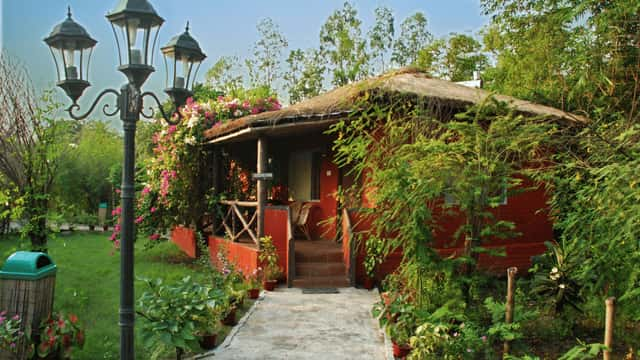
Executive Cottage, red-walled thatched cottage with bougainvillea and a lamp-lit garden path at Sundarban Tiger Camp, Sundarbans
The Sundarbans · Jungle camp

Sundarban Tiger Camp

On Dayapur Island opposite Sundarban National Park, this camp has been running cruise safaris into the mangrove waterways since 2004, you arrive by boat from Gadkhali along the Pitchkhali River. The 21 rooms, each hand-painted by a local artist and kept free of televisions, all have private balconies. Evenings bring a sundowner at the Mangrove bar and, some nights, a Bonobibi Jatra, the local play of the forest goddess.

Rates on request, usually back within the hour

Ask on WhatsApp

All 3 stays in West Bengal

Common questions

Do you need a permit to visit the Sundarbans, and where do you get it?
Yes. Permission to enter Sundarban Tiger Reserve is issued by the office of the Field Director at Canning in South 24 Parganas, West Bengal, and is also available at Sonakhali, Bagna, Sajnekhali and Jhingakhali. It is issued against an entry fee for the boat and for the visitors, plus camera and other charges. In practice the boat operator or the camp arranges it, because only boats already registered with the reserve are allowed in at all.
What does a Sundarbans permit cost for Indian and foreign visitors?
Sundarban Tiger Reserve does not publish its entry, boat and camera fees online, and its public booking console is not open for tourist bookings. Figures quoted on travel booking sites cannot be traced to a West Bengal Forest Department notification, so we do not repeat them. Ask the Field Director's office at Canning, or ask your camp to itemise the government charges separately from its own.
Do foreign nationals need a separate permit for the Sundarbans?
The reserve's own website gives two different answers. Its boat booking page says a special permit for foreigners is obtained from the Joint Secretary, Forest Department at Writers' Building in Kolkata. Its How to Reach page says no special permits are required for foreigners and that a visa and the usual documents are enough. Because the official source contradicts itself, a foreign passport holder should confirm with the Field Director's office at Canning before travelling.
Is there a jeep safari in the Sundarbans?
No. There are no forest roads. Sundarban Tiger Reserve states that launches and boats are the only means of transport inside it. A safari here is a cruise through tidal creeks, stopping at watchtowers such as Sajnekhali, Sudhanyakhali, Dobanki, Netidhopani and Burirdabri, where you can step off the boat. You may only get off at camps that are open to tourism.
Which watchtowers are open in the Sundarbans, and what is at each?
Sajnekhali has a mangrove interpretation centre, a crocodile pond, breeding enclosures for the northern river terrapin and a watchtower over a sweet water pond, with over 200 bird species recorded. Sudhanyakhali is a tower facing a sweet water pond with a planted mangrove park. Dobanki has a canopy walk of about 400 metres, roughly two hours by boat from Sajnekhali. Netidhopani, at the south-west tip of the tourism zone, has the ruin of a 400-year-old temple. Burirdabri, on the Bangladesh border, has a watchtower, a mud walk and a mangrove cage trail.
When is the best time to visit the Sundarbans?
Sundarban Tiger Reserve names October to March as the best season for a Sundarban tour. Its ticketing portal separately states that ecotourism in the Sundarbans is open throughout the year, so there is no published monsoon closure of the tourism zone in the way central Indian tiger reserves close from mid-June to the end of September.
How big is Sundarban Tiger Reserve and what protection does it have?
The reserve covers 2,584.89 square kilometres in West Bengal, made up of Sajnekhali Wildlife Sanctuary at 362.40 sq km, Sundarban National Park at 1,330.10 sq km and 892.43 sq km of reserve forest, split into 1,699.62 sq km of critical tiger habitat and 885.27 sq km of buffer. Sundarban National Park has been a UNESCO World Heritage Site since 1987, the Biosphere Reserve was constituted in 1989 and recognised by UNESCO in November 2001, and the Indian Sundarban became a Ramsar site in 2019 covering almost 4,23,000 hectares.
How do you get to the Sundarbans from Kolkata?
Kolkata is the nearest city and the nearest airport is Netaji Subhas Chandra Bose International at Dum Dum. The nearest railhead is Canning, with EMU trains from Sealdah roughly every hour. Buses to the boat jetties at Sonakhali and Godkhali run from Esplanade, and buses to Dhamakhali run from Sealdah, Babughat, Barasat and Science City. From Godkhali or Dhamakhali you continue by boat. The reserve publishes these routes but not road distances or journey times.
What are the rules on board a Sundarbans boat?
Passenger numbers are fixed by the specification of the boat, and the crew may not leave the prescribed route without permission from the Range Officer for the ecotourism range. Loud music is not allowed and silence is expected inside the forest. Drones, swimming, diving, fishing, alcohol, smoking and single-use plastic including water bottles are all prohibited. Every boat must carry a first aid box, life jackets and a fire extinguisher, fly the national flag between sunrise and sunset, and paint its licence number on the stern in letters readable at 20 metres.
Plan a trip · trusted local expert

The whole Sundarbans trip,
planned for you

Not just the room: drivers, trains, guides, the lot. Tell us the shape of the trip and Indiaesque builds it to your budget with our own people on the ground. No call centres, no mark-up mystery.

  • · A real itinerary from someone who lives there
  • · One WhatsApp conversation, from first idea to final itinerary
  • · Built and booked with Indiaesque — one clear price, taxes in
How many going?
The stay is a given — what else should we sort?

A real person replies on WhatsApp — no account, no password.

Deal alerts · free on WhatsApp

Never overpay
for ordinary

One tap on WhatsApp and you're on the list. Every new find reaches you before it reaches the site. Never spam, leave anytime.

Message us on WhatsApp

Opens WhatsApp — send the ready-made message, tap Join in our reply, done.

or we can message you

Free forever. We'll confirm on WhatsApp and send our best finds there — leave anytime.