Periyar Tiger Reserve runs to 925 square kilometres in the Cardamom Hills and Pandalam Hills of the southern Western Ghats, across the Idukki, Kottayam and Pathanamthitta districts of Kerala. Thekkady is the visitor end of it. A lake of about 26 square kilometres sits at the centre, made when the Mullaperiyar dam was built in 1895, and that lake is why the signature drive here is a boat rather than a jeep. The sanctuary came under Project Tiger in 1978 as the tenth tiger reserve in India, and the reserve is part of the Western Ghats UNESCO World Heritage site.
You will see two areas quoted. The reserve's own site says 925 square kilometres and Kerala Tourism's destination page agrees. Kerala Tourism's ecotourism page still says 777. Use 925.
There are no zones to book, there is a programme list
Nothing at Periyar works like a central Indian tiger park. No zone permit, no vehicle quota per gate, no Gypsy to hire at the barrier. The Kerala Forest Department runs a fixed menu of guided programmes through the eco development committees of the surrounding villages, and what you book is a programme.
These are the rates Kerala Tourism publishes. Nature Walk, two and a half hours over 4 to 5 km, Rs 350 a person, four to six walkers, six start times between 07:00 and 14:30. Green Walk, three hours on sandal protection trails with a tribal guide and five walkers at most, Rs 350 a person. Bamboo Rafting, a full day of trekking and rafting reporting at 07:45, Rs 2,400 a person, or Rs 1,800 for the half day. Border Hiking, 08:00 to 17:00 along the boundary between 900 m and 1,300 m with food included, Rs 1,800 a person, ten hikers in two groups. Jungle Scout, a night walk from 19:00 with armed guards, Rs 1,200 a person. Periyar Tiger Trail, one night at Rs 6,000 a person or two nights at Rs 8,400, six people at most. Bamboo Grove, a bamboo hut with meals and a boat ride, Rs 4,000 a cottage. Jungle Inn at a watchtower, Rs 2,000 for two. Jungle Camp, tents with meals and a Gavi safari, Rs 5,000 for two.
None of those rates includes the park entrance fee. The reserve's FAQ explains why: the programmes are run and ticketed by the eco development committees, and entry is a separate government charge.
The boat, and how the seats are really sold
The lake cruise goes five times a day, at 07:30, 09:30, 11:15, 13:45 and 15:30, and runs an hour and a half.
Each departure carries 120 seats, and the reserve releases about 25 of them online. The other 95 are sold at the counter on the day. Checking the reserve's own portal four weeks ahead, the online allocation on every single departure was down to one seat or none.
That is 600 seats a day across the whole reserve, and 125 of them bookable in advance. Turning up on the day and hoping for a boat is not a plan in season. Book the online seat the moment your dates are fixed, or be at the Anavachal counter when it opens and expect to queue.
Report an hour before at the Anavachal parking ticket counter and thirty minutes before at the boat landing, carrying the ID you booked with. Life jackets are compulsory and nobody may stand during the ride.
There is a second boat programme. The Periyar Cruise runs two boats of eighteen, 36 seats in all, at Rs 1,000 a head for Indian and foreign visitors alike, with binoculars, cushioned seating and refreshments.
What it costs, broken down
The government charges are small. From the reserve's own booking system, the standard boat ticket is Rs 255 an adult and Rs 85 a child of 5 to 11. A still camera is Rs 45 and a video camera Rs 335. Parking is Rs 85 for a car, Rs 335 for a bus and Rs 45 for a two-wheeler.
Park entry is charged on top of all of that, and so is the shuttle bus to the boat landing. The reserve does not publish a plain visitor entry fee anywhere we can verify it, so we are not going to quote you one. The boat ticket is the charge nearly every visitor actually pays, and entry is settled at the ticket counter when you collect.
Two adults on the standard cruise therefore pay Rs 510 for the boat, the same figure whether they are Indian or foreign. A full day's guided walking is Rs 350 a head on top of that.
The guides were poachers
Kerala Tourism's own page for the Tiger Trail says it without decoration: "Guides are locals who were once poachers. These poachers turned protectors of the forest have a thorough knowledge of the forest." The reserve lists 81 eco development committees, and the programmes are run through them, which is the mechanism that turned the people who used to take from this forest into the people paid to protect it.
The trail takes six people, walks 20 to 35 km over one or two nights, camps in tents with vegetarian meals, and goes out with armed forest guards. On the reserve's booking portal the one-night trail departs Monday to Friday and the two-night trail on Saturdays. Six places a departure is the whole supply.
The rules that catch people out
An entrance ticket is not a boat ticket. The reserve's FAQ is explicit: entry is valid for the park between 06:00 and 17:00, boat seats are limited and sell out, and you can hold one without the other.
Children under 12 are barred from the programmes that involve trekking, and the Tiger Trail is 12 to 70 only. Most walks have a minimum party of four and are charged at the minimum if you are fewer. Miss the reporting time and the ticket is at risk.
Where we are
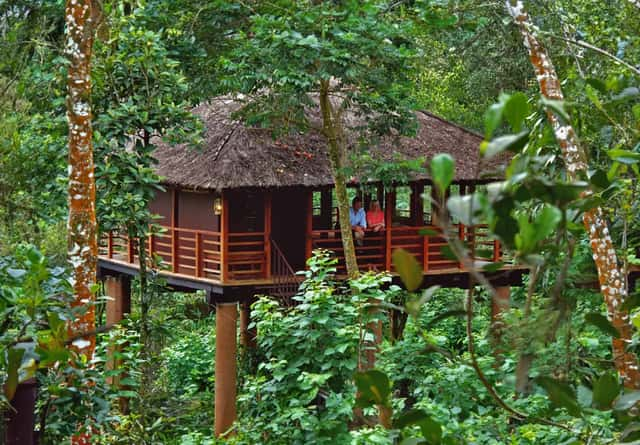
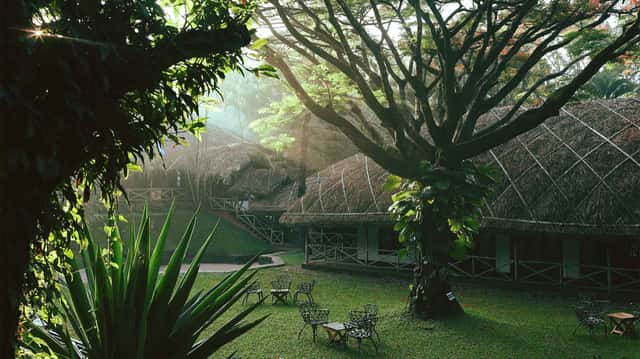
Spice Village is a CGH Earth resort at Thekkady, 52 cottages roofed in elephant grass by Mannan thatchers on twelve acres of spice and forest garden, with the reserve at the door. Carmelia Haven is a 30-minute drive away at Vandanmedu, tree houses and plunge-pool villas on a working tea and cardamom estate. Neither has a trip from us yet.
Getting there
Kerala Tourism gives Kottayam as the nearest railhead at 110 km and Cochin International Airport at 190 km. Both are long road transfers through the hills, so the day you arrive is a travelling day.