Dudhwa Tiger Reserve lies in the Lakhimpur Kheri district of Uttar Pradesh, along the Indo-Nepal border, and it is three protected areas rather than one. Dudhwa National Park runs to about 811 square kilometres of marsh, grassland and sal forest on the alluvial plain of the Mohana and Suheli. Kishanpur Wildlife Sanctuary, founded in 1972, sits about 30 km away along the Sharada, with agricultural land in between, so the two cores are not contiguous. Katarniaghat Wildlife Sanctuary is a further block of 400.09 square kilometres in Bahraich district, with a buffer of 150.03 square kilometres in the Motipur and Kakraha ranges, built around the Girwa and Kaudiyala streams of the Ghaghra.
This is the Terai, and it is quiet. Uttar Pradesh Ecotourism puts it plainly on its own page: unlike the celebrity parks such as Corbett, Kaziranga and Bandhavgarh, Dudhwa is uncommercialised. That is the reason to come.
The gates, and who sits by them
The state portal sells drives at three Dudhwa locations: Dudhwa National Park, Kishanpur and Katarniya Ghat. Each has its own departure points.
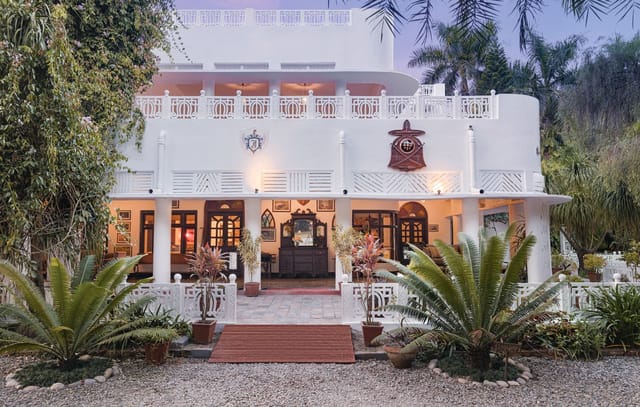
Kishanpur is 13 km from Bhira town in Lakhimpur Kheri. Camp TigerLily is at Village Bhira, on the edge of the sanctuary, with rooms looking onto reserve forest and a sal-wood lobby built round an old fireplace. It runs drives into all three blocks, Dudhwa, Kishanpur and Katarniaghat, and its own count of the birds here is over 450 species. Its two-night trip is the one we sell at Dudhwa.
Dudhwa National Park is entered from Palia Kalan. Jaagir Manor is there, an eighty-year-old hunting lodge of nine suites and six villas around an outdoor pool, with dinner at the Jaagir Pavilion and drinks at the Safari Club.
Katarniya Ghat is the third block. The forest department's own campuses at Motipur and Kakraha hold four cottages each, air-conditioned huts built in the Tharu style inside a walled compound, with canteens, no televisions and no promise of a mobile signal. Boating on the Girwa runs from here as well as jeeps.
What is actually in there
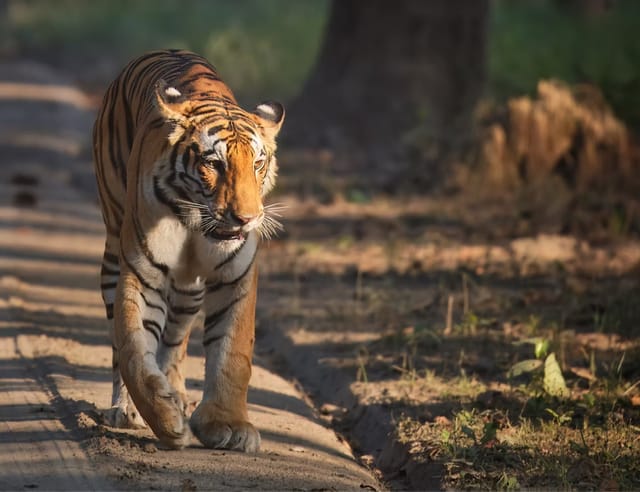
Dudhwa holds over 38 species of mammal, 16 of reptile and over 450 of bird out of roughly 1,300 in the Indian subcontinent. Two of its animals are worth booking a trip around, and the state's own pages confirm both.
Swamp deer, the barasingha, is the state animal of Uttar Pradesh. Jhadi Tal, the main waterbody of the Kishanpur sanctuary, holds the highest number of them, and the count there sometimes reaches 800.
The one-horned rhino is here by reintroduction. Seven were moved from Assam and Nepal in 1984 and 1985 to rebuild a population that had lived in this country 150 years earlier. Katarniaghat's official species list carries *Rhinoceros unicornis* alongside gharial, Gangetic dolphin, Bengal florican, hispid hare and the white-backed and long-billed vultures.
What a safari costs, broken down
Uttar Pradesh charges the entry fee per person and the vehicle by the vehicle, and it publishes both.
Entry is Rs 250 a person a trip for Indian nationals and Rs 2,000 for foreign nationals. A child over five pays Rs 100 or Rs 1,400 on the same split.
A full vehicle takes seven people. From the Dudhwa National Park departure point it is Rs 4,000; from the Dudhwa Tourism Premises it is Rs 5,000. Katarniya Ghat runs the same two figures, Rs 4,000 from Katarniya Ghat itself and Rs 5,000 from Motipur or Kakraha. The guide fee and the road fee are already inside those numbers, which is unusual and worth noting: at most Indian tiger reserves the guide is billed separately.
So four Indian nationals sharing a jeep from Dudhwa pay the state Rs 5,000 for the drive. Four foreign nationals pay Rs 12,000, and almost all of that difference is the entry fee rather than the vehicle.
A lodge-arranged drive at Dudhwa costs more, and the spread is by zone as well as by nationality. Across our own rate cards here, a jeep for up to four runs roughly Rs 6,500 for the Kishanpur zone and Rs 8,000 for the Dudhwa and Sathiyana zone for Indian nationals, and roughly Rs 14,500 and Rs 16,000 for foreign nationals. The gap over the state charge buys the permit, a vehicle that is the lodge's own, a naturalist riding alongside the forest guide the rules require, and somebody getting you to a gate 13 km away before the shift opens.
Two extras are billed separately and catch people out. Entry to the rhino area is charged per person on top, at a steep multiple for foreign nationals. An elephant ride is priced per group rather than per head.
The rules that catch people out
The evening shift will not let you in after 4:00pm, whatever time sunset is. Shifts run 7:00am to 10:00am and 3:00pm to sunset in winter, and 6:00am to 9:00am and 4:30pm to sunset in summer.
Seven people to a vehicle, including the driver and the guide. One authorised guide per vehicle is compulsory and must be paid for before entry.
The state's own conduct rules are specific. Keep 50 metres between vehicles. Do not exceed 20 kmph. Stay 20 metres from any animal, and if one walks towards the jeep, stop and let it pass. Do not spend more than five minutes at a sighting. Mobiles off in the core, no music, and nobody gets out of the vehicle except at authorised places.
When it is open
Uttar Pradesh Ecotourism gives the visiting season for Dudhwa, Kishanpur and Katarniaghat alike as 15 November to 15 June. It publishes no separate monsoon closure notice for the three, so confirm your dates on the portal rather than assuming a shoulder month will be selling.
One thing the state has not settled is how big Kishanpur is. Its own page gives the sanctuary as 200 square kilometres in one sentence, 227 in the next and 203 further down. Nothing turns on it for a visitor, but it shows how lightly documented this reserve still is.
Getting there
Dudhwa is 228 km from Lucknow and 427 km from Delhi by road. Kishanpur is 225 km from Lucknow and 100 km from Shahjahanpur, which is also its nearest railhead. Katarniaghat is 203 km from Lucknow and 501 km from Delhi. Lucknow is the airport for all three, about 250 km from Dudhwa. Those are four to six hours on the road, so the arrival day is a travelling day and not a safari day.