Things To Do In Lucknow
Entry fees, opening times and fares in India change often. Please check before you travel.
New Planning with ChatGPT or Gemini? Paste the plan and we'll price it with real hotels and a car. Price my itineraryFirst time in India? How long, where and when to go, in one page.
Lucknow trips from ₹23,999 per person, everything in the price ↓
Lucknow is the first of three stops on Varanasi Ayodhya Lucknow 5 nights · with Ayodhya and Varanasi · from ₹49,000 per person See it →Lucknow is the city of the Nawabs of Awadh, the capital they built when their court moved from Faizabad in the late 18th century, and the place where a particular idea of northern Indian refinement reached its peak: in food, in embroidery, in music, in manners. Delhi has more monuments and Jaipur more postcards, but Lucknow has tehzeeb, a courtesy and a way of doing things that you can still feel in the older parts of the city.
It is also, quietly, the best-value weekend city in north India. Direct flights land from every metro, the food is extraordinary and cheap, the crafts are made in home workshops you can actually visit, and the monuments are largely uncrowded. Two nights is enough to understand why people who know India keep going back.
This guide covers what's genuinely worth your time in 2026, the Nawabi monuments, the 1857 sites, the food, the chikankari, with a suggested weekend shape at the end.
The Monuments of the Nawabs
The showpiece is the Bara Imambara complex in the old city, Asaf-ud-Daula's vast congregation hall, built in the 1780s as a famine-relief project, with its central vaulted chamber and the bhulbhulaiya, the labyrinth of passages above it. Next to it stands the Rumi Darwaza, the ornamental gateway that has become the city's emblem, and further along the Husainabad road the Chota Imambara with its chandeliers and gilded dome.
The other great Nawabi quarter is Qaiserbagh, Wajid Ali Shah's palace complex, of which the remnants (gateways, the Safed Baradari, the tombs) reward a slow wander. Guided heritage walks run daily in the old city, a shared walk through Chowk's lanes costs from about ₹2,750 per person, and dedicated Qaiserbagh and Hazratganj walks also operate on fixed afternoon schedules. Worth taking: the layers of this city are easy to miss on your own.
1857: The Residency and the Siege
Lucknow was the centre of the 1857 uprising's most famous siege. The Residency, the shattered British compound, kept as a ruin, is one of the most atmospheric historical sites in India: cannon-scarred walls, a small museum, and lawns where the city comes to walk in the evening.
For anyone serious about the history, a full-day 1857 route also takes in La Martiniere (Claude Martin's extraordinary school-palace), Sikanderbagh, Shahnajaf, Dilkusha and Alambagh, the geography of the relief columns. Specialist-guided versions of this day run at about ₹11,000 per person including car, entrances and lunch.
The Food
Awadhi cuisine is the city's great export and its great reason to visit: the galawat kabab (invented, the story goes, for a toothless Nawab), kakori kababs, slow biryanis that are subtler than Hyderabad's, sheermal, and in winter, makhan malai at dawn in Chowk.
Do it two ways. Graze the institutions, the kabab and biryani houses of Aminabad and Chowk, the kulfi and chaat corners, ideally on a guided evening food walk (from about ₹1,500–2,500 per person with a guide who knows every counter). Then, for the other end of the spectrum, book a home-style Awadhi dawat: Naimat Khana serves home-cooked Awadhi food in a 1950s Art Deco bungalow, with recipes collected from old Lucknow families, veg and non-veg menus, dinner by arrangement. Kotwara House, the Qaiserbagh residence of filmmaker Muzaffar Ali, also hosts curated lunches and dinners on a fixed family menu, by appointment.
Chikankari and the Craft Lanes
Lucknow's chikankari, white-on-white shadow embroidery, is still stitched by hand across the old city, and Chowk's lanes hold the wider craft world around it: silver warq beaters, gem polishers, zardozi metal-thread workshops, and the flower-jewellery makers of Phool Wali Gali. A guided craft walk gets you into workshops you would never find alone.
Better still, learn some of it: hands-on sessions run in the city for chikankari, zardozi and calligraphy (roughly ₹1,500–2,500 per person), and there are home workshops where families have carved bone for generations. For buying, the Sanatkada craft shop in Qaiserbagh gathers honest handloom and craft from across the country under one roof.
Music, Poetry and the Evening Arts
Lucknow is one of the homes of Kathak and of the courtly musical tradition, Begum Akhtar is buried here, and the gharanas still teach. Private evenings can be arranged around the city's performing arts: qawwali, dastangoi (the revived Urdu storytelling form), ghazal and Kathak recitals. The Lucknow Bioscope, a small museum of the city's culture in Qaiserbagh, is worth an hour to put it all in context.
Day Trips
Ayodhya is about 135km east and works as a long single day from Lucknow: the Ram Janmabhoomi temple, Hanuman Garhi, Kanak Bhawan, and the ghats of the Saryu with the evening aarti. Organised same-day returns with a car, guide and lunch run at about ₹13,500 per person. Closer to the city, hosted village lunches, a cooking demonstration in a mango orchard, then the full spread, make an easy half day.
Where to Stay
A stay at one of our Lucknow hotels with what it does best already in the price, from ₹23,999 per person, two sharing, taxes in. You book with Indiaesque; a person sets the whole thing up.
Saraca Hotel Lucknow is the boutique pick, a white Art Deco house from 1936 on Mall Avenue, refurbished in 2016, with 41 rooms around a central courtyard, an Awadhi restaurant, a pool and a rooftop lounge. It's the base for our Essential Lucknow weekend, two nights with the Aminabad food walk, a chikankari workshop and a home-cooked dawat built in, from ₹11,599 per person.
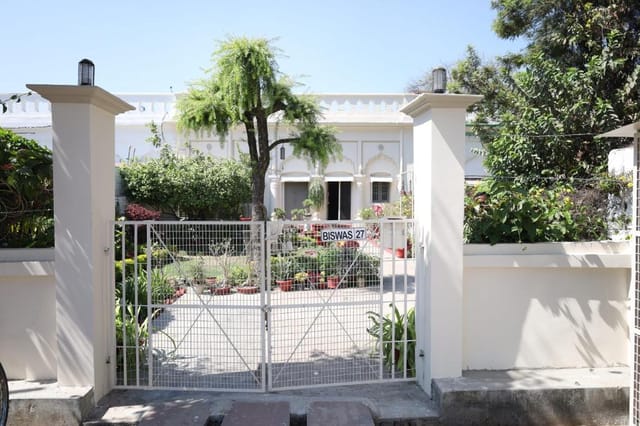
For something smaller and more personal, Maqbara 27 is a restored two-room heritage bungalow on Maqbara Road, a quiet, leafy pocket in the heart of the city, overlooking the Sibtainabad Imambara and a short walk from Hazratganj. You take the whole house: two very different bedrooms, Parikhana, all Awadhi motifs and handcrafted woodwork, and Firangi Mahal, colonial in mood with vintage European furniture, plus a living room lined with books on Lucknow, a dining room under vaulted arches, and a genuinely lovely garden. Breakfast is included (English or Awadhi, tell the caretaker the night before), the rooms are air-conditioned, wifi and parking are free, a small kitchen is available on request, and a house manager lives on site. ₹13,000 a night plus GST for the entire house, it suits a family or two couples travelling together. Ask us and we'll arrange it.
If you'd rather stay somewhere with a story to it, we keep a short list of boutique hotels in Lucknow, places we'd send a friend.
Getting There and Around
Chaudhary Charan Singh International Airport has direct flights from Delhi, Mumbai, Bengaluru, Hyderabad, Kolkata and most metros; the city is also well connected by train from Delhi. Within town, Ubers and autos are cheap and everywhere, though the old city is best on foot, which is rather the point.
October to March is the season: dry, cool mornings, and the winter-only foods (makhan malai above all) in full flow. Summer is fierce; the monsoon has its own green charm at the garden properties.
A Weekend Shape
Day one: land, check in, and spend the evening eating through Aminabad with a guide. Day two: chikankari in your hands in the morning, the Bara Imambara and Rumi Darwaza in the late afternoon light, a dawat dinner. Day three: the Residency early, a slow breakfast, home. That's the skeleton of our Essential Lucknow package, or ask and we'll build the 1857 day, Ayodhya, or a Kathak evening into it.