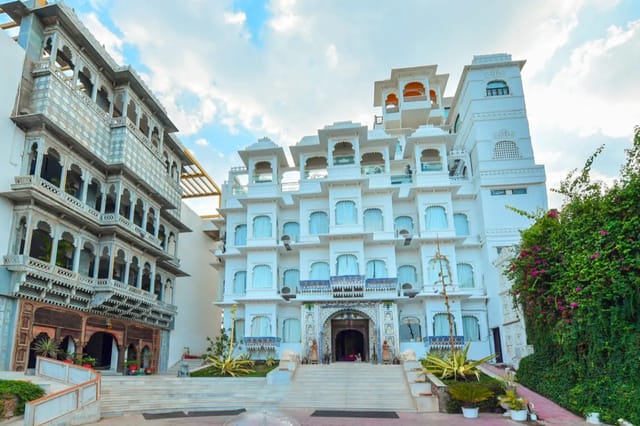
Udaipur · Boutique hotel
Udaipur
Sixty four rooms above Hanuman Ghat and the oldest rooftop pool in Udaipur, by the house's own telling. Dusk up there outshines the palace bars.
Rates on request, usually back within the hour
Ask on WhatsApp"An 1860 Rajput garden palace where a festival first found its voice"
Some heritage hotels trade on borrowed grandeur. Diggi Palace has the real thing, quietly: a low-slung 1860 house set behind lawns in the middle of Jaipur, still part-lived-in by the family who built it. You arrive expecting a hotel and find yourself in someone's ancestral home instead, one where, for years, the entire literary world came to sit on the grass every January.
The palace was built in 1860 by Thakur Saheb Pratap Singh Ji Diggi, of the then-ruling family of the Diggi principality. The Diggis are Khangarot Rajputs, and Diggi itself is a *thikana*, a nobleman's estate, about 75 km south-west of the city, back when this was all part of the Jaipur state. The house in town began life as a *Bagh*, a garden retreat, somewhere the family stayed when they came to Jaipur and held court to run the affairs of the estate. That origin story still explains the place. It was designed around gardens and shade and open air, not around a lobby, and it feels that way to walk into.
It only became a hotel in 1991, when Thakur Ram Pratap Singh Diggi and his wife Jyotika Kumari Diggi opened part of the property to guests. The word *part* matters. The family still lives here and still runs it, which is why the welcome lands somewhere closer to being a houseguest than a customer.
Here is the thing that makes people who know India go quiet when you mention Diggi Palace. In 2006, two writers, Namita Gokhale and William Dalrymple, started a small literary gathering on these lawns. The first edition drew about a hundred people, a few of whom, in Dalrymple's own telling, had simply wandered in lost. That gathering was the Jaipur Literature Festival, and for the next decade and a half it belonged to this courtyard.
Every January the lawns filled with tents and folding chairs, writers famous and obscure argued under the trees, and chai went round in the cold morning air. It grew and grew until, in 2022, it finally outgrew the walls and moved to a bigger venue across town. But if you want to stand in the spot where all of it began, you stand here. Come outside festival season and the lawns are just lawns again, which is its own kind of luxury.
Dining splits neatly in two. Baradari is the heritage restaurant, the one to book for Rajasthani and Indian cooking served in the old-world setting the house does so well. La Brass is the change of register, a more relaxed room for when you don't want another grand dinner and just fancy something easy. Between them you can eat here happily for several days without repeating yourself, which, given how central the hotel is, you may well end up doing.
What Diggi does best is the space between plans. There's a swimming pool and a spa for the flat middle of a Rajasthan afternoon, when the light goes white and sightseeing loses its appeal. There are the lawns and gardens the whole place was built around, deep and green and made for doing nothing in. And there are the courtyards and the long veranda, the shaded edges of a house more than 160 years old where you can sit with a book and lose an hour without noticing.
It is not a polished five-star machine, and that's the point. Free Wi-Fi and a proper spa sit alongside creaking heritage and family history, and the trade is worth making. You come to Diggi Palace for somewhere with a memory, a real house, a real family, and a patch of grass that once held the whole conversation of Indian letters. Pull up a chair on the veranda. This is a place that rewards staying put.
Some facilities and experiences may be chargeable.
In Jaipur, Rajasthan. The nearest airport is Jaipur (JAI).
Diggi Palace is on Shivaji Marg in C-Scheme, Jaipur 302004. It is roughly 11 km (30–40 minutes by road) from Jaipur International Airport at Sanganer, and minutes from Jaipur Railway Station, Hawa Mahal and the historic Walled City.
The palace dates back to the early 1730s and is recognised as a heritage hotel by the Government of India. It was also home to the Jaipur Literature Festival from the festival's founding in 2006.
There are four categories — Courtyard Room, Palace Room, Heritage Deluxe and Heritage Standard — all featuring original stonework, ancestral art and abundant natural light. Every stay includes Wi-Fi, complimentary breakfast, a tea/coffee maker and cable TV.
Baradari Restaurant serves authentic Rajasthani cuisine all day beneath the palace arches, including a Royal Rajasthani thali with laal maas, dal baati churma and gatte ki sabzi. La Brass at Diggi is an all-day bistro serving global and Indian fusion food.
Check-in is at 2.00 pm and check-out at 11.00 am, with early check-in and late check-out available on request.
Yes — the hotel lists pet-friendly accommodation, along with a swimming pool pavilion, spa services and ancestral gardens. Event venues accommodate up to 500 guests for weddings and corporate events.
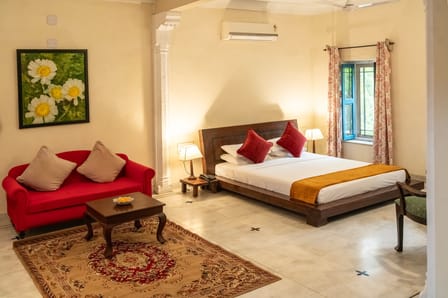
Hand-painted ceilings, a separate sitting area, and windows framing the gardens and pool.
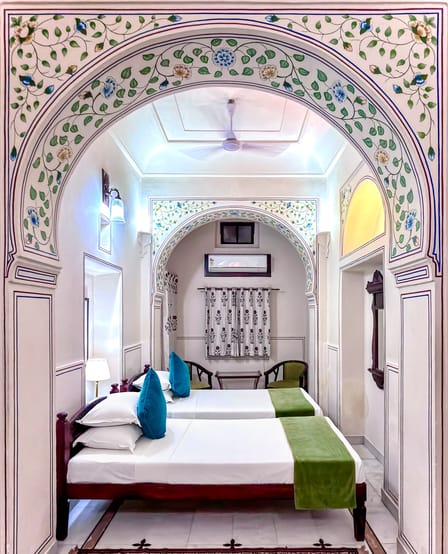
Generous rooms carrying the original character of the haveli — antique detailing and garden light.
Sixty four rooms above Hanuman Ghat and the oldest rooftop pool in Udaipur, by the house's own telling. Dusk up there outshines the palace bars.
Rates on request, usually back within the hour
Ask on WhatsApp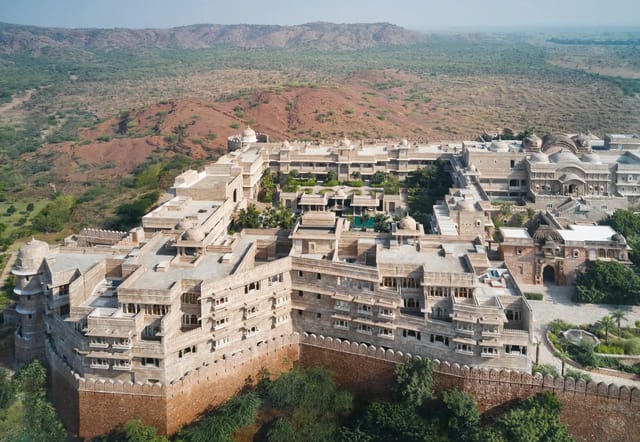
A 14th-century walled fort near Ranthambhore, restored over more than a decade into 48 contemporary Rajasthani suites, with two palaces, two temples and a 30,000 square foot spa inside the ramparts.
Rates on request, usually back within the hour
Ask on WhatsApp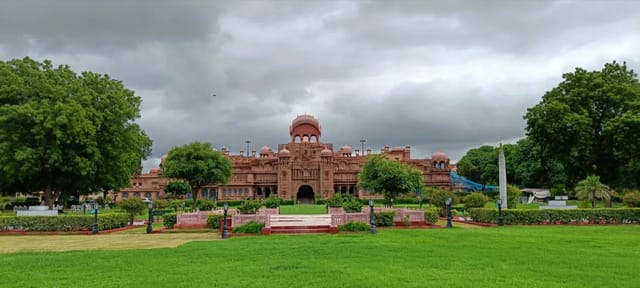
A red-sandstone palace on the edge of the Thar, raised by the Maharaja of Bikaner in 1904 and famous, even then, for guests who never quite wanted to leave. Domes and cupolas, deep-carved friezes, filigree stonework and latticed screens, set in formal lawns. The Laxmi Niwas Palace is the royal house of Bikaner, now a heritage hotel.
Rates on request, usually back within the hour
Ask on WhatsAppLeave an email or a WhatsApp number, whichever you prefer. A person replies and takes care of the whole booking with you.
One tap on WhatsApp. No password, no card, leave anytime. Every new find and every deal lands with you first.
Message us on WhatsAppOpens WhatsApp — send the ready-made message, tap Join in our reply, done.
You're on the list the moment you're done. Done it? Continue →
Nothing arrived? Send us a quick “hi” instead — that works every time. Message us on WhatsApp →
Your booking is handled personally by the Indiaesque team, start to finish — no call centre, no middlemen.
You're in. 🎉 New finds land on your WhatsApp before they land here, and a real person is one message away.
One tap on WhatsApp and you're on the list. Every new find reaches you before it reaches the site. Never spam, leave anytime.
Message us on WhatsAppOpens WhatsApp — send the ready-made message, tap Join in our reply, done.
You're on the list the moment you're done. Done it? Continue →
Nothing arrived? Send us a quick “hi” instead — that works every time. Message us on WhatsApp →
Free forever. We'll confirm on WhatsApp and send our best finds there — leave anytime.
New finds reach the list first — on WhatsApp, before the site. Free, leave anytime.
We use cookies to measure how the site is used and how well our ads work. That includes cookies set by PostHog, Microsoft Clarity, Meta and Google. How we use them.