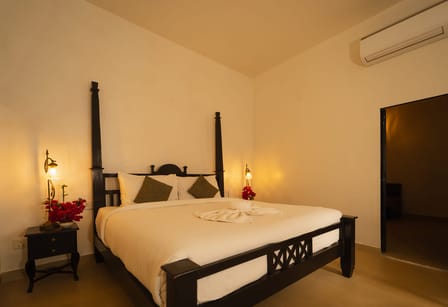
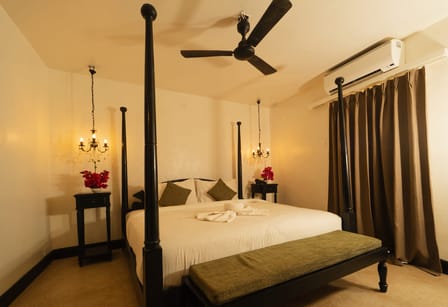
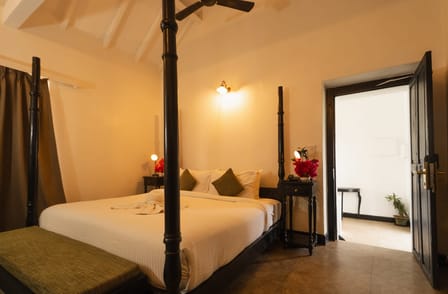
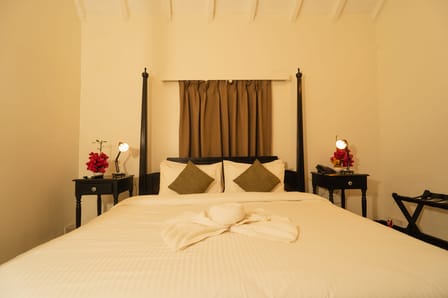
Drive to the very top of Goa, past the last of the beach shacks and the last of the road, and you arrive at a river. A small ferry carries you across the Terekhol, Tiracol on the older maps, and up a green headland to a white-walled fort that has been watching this water for some four hundred years. Step through the gate and you are, quite literally, checking into history: only a handful of rooms, a working church, and ramparts that fall straight to the Arabian Sea.
A fort that changed hands
The fort was raised in the seventeenth century by Khem Sawant Bhonsle, the Raja of Sawantwadi, whose navy sheltered in the river mouth below. The Portuguese wanted the position, and in November 1746 a viceroy named Pedro Miguel de Almeida sailed his fleet up the Terekhol and forced its surrender. It then stayed Portuguese for more than two centuries, far longer than almost anywhere else in India, right up until 1961. That is the quiet marvel of the place. You sleep behind walls that passed between a Maratha king and a European empire, on a headland most of India never quite reached.
The church within the walls
After de Almeida took the fort, he built a chapel in its courtyard. It grew into the small Church of St Anthony that still stands inside the ramparts, whitewashed, unfussy, arched, with mass said on Sunday mornings for villagers who come across the river for it. There is something disarming about a genuinely living church a few steps from your bed: not a museum piece, not a photo backdrop, just quietly getting on with its centuries while you drink your morning coffee nearby.
The patriots' fort
There is a heavier memory here too, and it is worth carrying up onto the ramparts. On 15 August 1954, unarmed satyagrahis crossed into Portuguese-held Goa from the north, occupied Tiracol and flew the Indian flag above it for a day before they were captured and the fort was retaken. Goa would not become part of India for another seven years. Stand where they stood, with the wind coming off the sea, and the view is not only beautiful, it is a little bit consecrated.
A handful of rooms, and the long table
This was never built to be a big hotel, and thank goodness. There are only a handful of rooms inside the walls, most of them facing the open sea, one looking onto the church courtyard, long named, charmingly, one for each day of the week. Because there are so few, the fort is never a crowd; you tend to have a whole rampart to yourself. When hunger arrives, The Tavern does tapas-style small plates that borrow happily from Portugal, Goa and India, with cocktails poured as the light drops over the water. Slower mornings belong to Terrazo, the open-air garden café, where all-day means exactly that.
What you'll actually remember
Not the room, in the end, but the walls. Terraces cut into the old ramparts with the river on one side and the whole Arabian Sea on the other; a starlit amphitheatre where the evening simply unspools; the ferry crossing that quietly separates you from the rest of Goa on the way in. Tiracol is not for people who want the beach-shack circuit, it is for people who want to be somewhere that has stood still, gracefully, while everything around it moved. Come for a couple of nights, watch the sea change colour four hundred years' worth of times over, and leave a little reluctant. That is rather the point.