Kanha runs to 940 square kilometres across the Mandla and Balaghat districts of Madhya Pradesh, in the Satpura-Maikal hills. Safaris are made in four zones, and the reserve names them by compass point: Central Kanha (Kanha), West Kanha (Kisli), South Kanha (Mukki) and North Kanha (Sarhi). Three gates let you in. Which gate you sleep beside decides how the morning goes, because a drive starts at the gate and the queue forms before first light.
The gates, and who sits by them
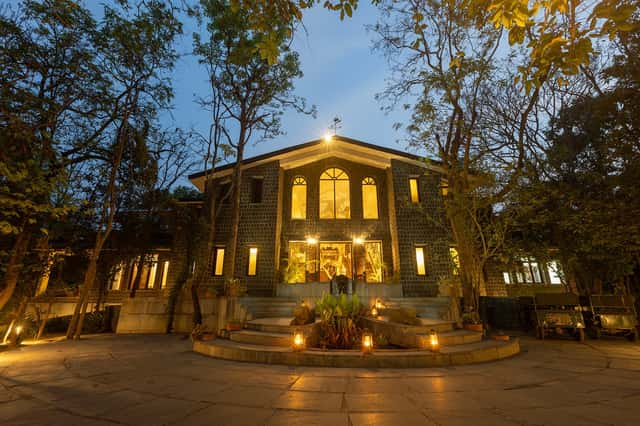
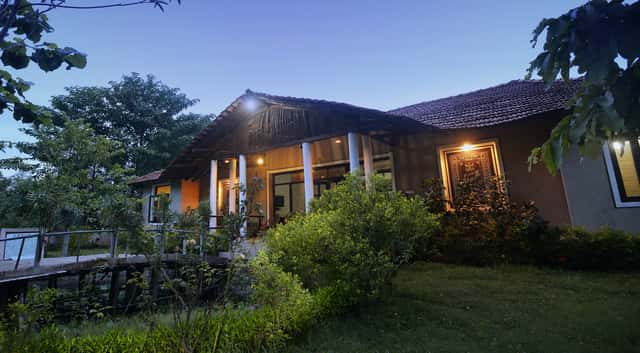
Khatia opens onto the Kisli side, about 160 km from Jabalpur by way of Mandla. Soulacia is a two-minute drive from it, at Village Khatia. Its two-night trip carries a core zone safari inside the price.
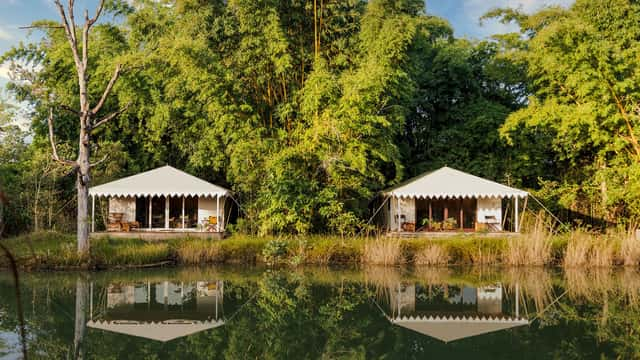
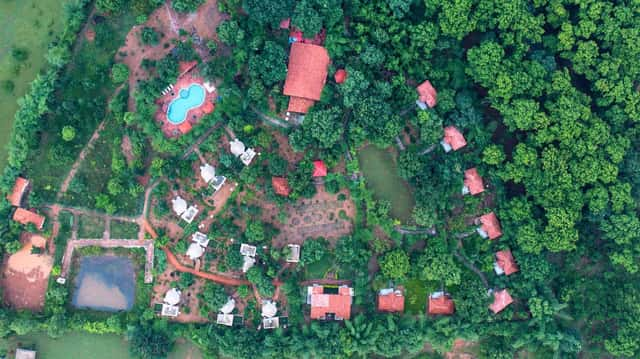
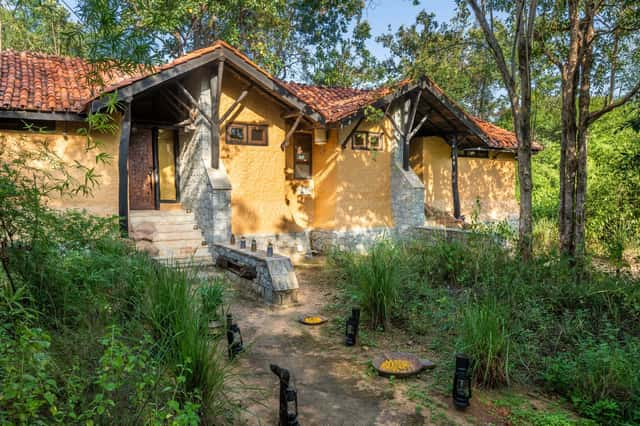
Mukki is the southern gate, on the Balaghat side, roughly 200 km from Jabalpur and 210 km from Raipur. Singinawa Jungle Lodge has twelve cottages on a hundred acres of its own forest near Kohka village, and keeps the Kanha Museum of Life and Art on the estate. Its two-night trip is the other one we sell here. Bagh Villas is a smaller camp at Baherakhar village, with shikar-style tents on raised platforms along a rain-harvested lake.
Sarhi is the northern gate, about 8 km off Bichhiya on NH 12A. The reserve treats it as a day-visitor gate and keeps around eight rooms there. We hold nothing at Sarhi.
How many jeeps actually get in
A permit is for one zone and one round, and the number of vehicles is capped by the forest department. The portal publishes the cap for every zone, split between permits sold online in advance, a waiting list, a Field Director's quota and single seats sold at the gate.
On a morning round the core takes 36 vehicles in Kanha zone, 30 in Mukki, 19 in Sarhi and 15 in Kisli. Of those, 24, 21, 13 and 9 are sold online as full-vehicle permits. The evening round is smaller: 23, 28, 17 and 10 vehicles, of which 17, 19, 11 and 7 go online.
So across the whole reserve, 67 jeeps can be booked online for a morning drive and 54 for an evening one. That is the entire advance-bookable supply for 940 square kilometres, and it is the reason a good lodge is worth more than a good room.
The buffer takes more. Khatia buffer runs 25 vehicles in the morning and 15 in the evening, Khapa and Sijora 20 and 12 each, and the Phen Sanctuary 25 and 15.
What a safari costs, broken down
The government's own charges are published and they are modest. A full-vehicle permit is Rs 1,500, the same figure for Indian and foreign visitors, valid for one zone. A single seat is Rs 250. A guide is compulsory and is allotted off a roster rather than chosen; the fee goes by the guide's grade, Rs 600 for a G-1 and Rs 480 for a G-2. Only registered Gypsies may enter, hired gate to gate at Rs 2,000 a safari, and no private vehicle is allowed in. That is Rs 3,980 to Rs 4,100 a drive for a jeep of six, before the portal's booking fee.
Two official figures for the guide are in circulation and the older one is still on the reserve's own FAQ, which says Rs 360. The state's 2019 gazette amendment, published on the same portal, replaced it with the Rs 480 and Rs 600 grades. The gazette is dated and binding, so that is the figure to budget on. The Gypsy rate is set by the state tourism corporation rather than by the wildlife rules and moves separately.
A drive arranged by a lodge costs more than that. At Kanha it runs roughly Rs 10,000 to Rs 18,000 for Indian nationals, depending on the lodge and the zone, and foreign nationals pay a higher rate again. The gap is not padding, and it is worth knowing what it buys.
The lodge holds the permit, which is the hard part when 67 vehicles a morning go on sale months ahead at eleven o'clock and are gone. The vehicle is the lodge's own rather than whichever Gypsy is free at the gate. A lodge naturalist rides with you alongside the forest guide the rules require, and that naturalist is the difference between driving through a forest and finding something in it. Somebody also gets you fed and to the gate before six in the morning.
Our own Kanha trips carry a core zone drive inside the price, so there is one figure, one payment, and no permit for you to chase.
The rules that catch people out
One permit covers one zone. The other three are out of bounds on that drive. Seeing Kanha properly means several drives, not one long one.
The park closes to afternoon safaris every Wednesday, and all day on Holi and Diwali. A two-night trip built across a Wednesday loses a drive.
Two rounds run each day, sunrise to sunset with the park closed between 11:00 and 15:00. From 1 October 2026 the times are: October and November, in at 06:00 and out by 11:30, afternoon 15:00 to 18:00. December and January, morning entry 06:20. February and March, 06:10 in, and the afternoon runs to 18:30. April, May and June, in at 05:30 and out by 11:00, afternoon 15:30 to 19:00.
Six people to a vehicle, not counting the guide and the driver. Children up to five years old go in free. Late at the gate and the permit is at risk, which is the other reason the two-minute lodge beats the forty-minute one.
When it is open
The reserve's own FAQ gives the season as 1 October to 15 June, closed from 16 June to 30 September. Madhya Pradesh Tourism publishes 15 October to 30 June. Two official sources, two answers. The forest portal settles it in practice: it opened advance bookings for 1 to 31 October 2026 on 1 August, so the park is selling drives from 1 October. Confirm your own dates on the portal before you book flights.
What nobody disputes is that the core is shut through July, August and September. The buffer zones at Khatia, Khapa and Sijhora stay open in those months, and so does the Phen Sanctuary.
The reserve's own weather table is worth reading before you pack. January can drop to 1°C with frost. May reaches 42°C. The months it names as best are November to December, and March to May.
Getting there
From Khatia gate: Jabalpur 160 km via Mandla, Nagpur 220 km via Seoni, Raipur 250 km via Chilpi. From Mukki gate: Jabalpur 200 km via Mandla and Baihar, Raipur 210 km via Chilpi, Nagpur 260 km. Gondia is the nearest railhead to Khatia at 145 km. Every one of those is a road transfer of several hours, so the day you arrive is a travelling day and not a safari day.