Things to Do in Jodhpur
Entry fees, opening times and fares in India change often. Please check before you travel.
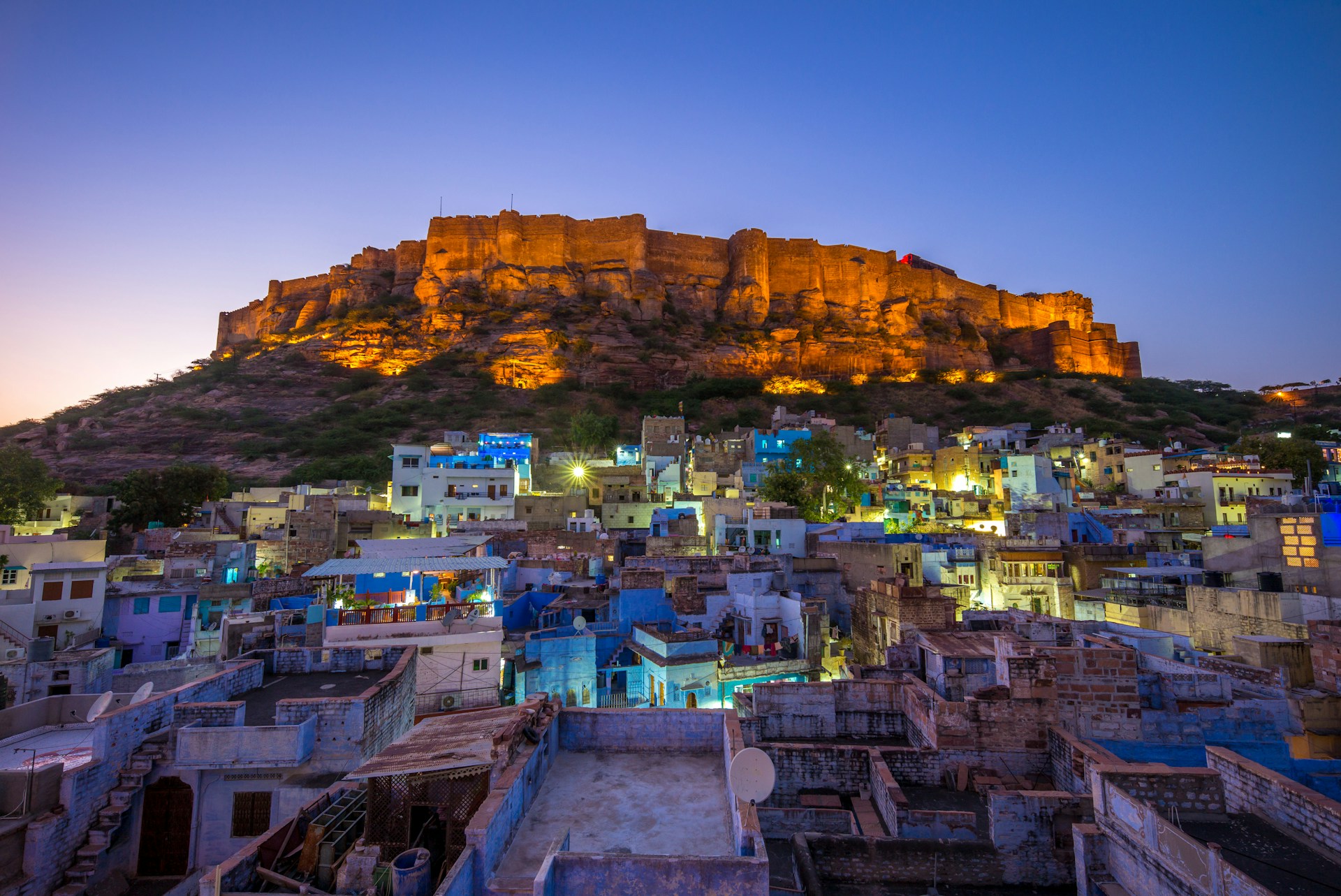
New Planning with ChatGPT or Gemini? Paste the plan and we'll price it with real hotels and a car. Price my itinerary Jodhpur is the second of two stops on Jaipur & Jodhpur 4 nights · with Jaipur · from ₹24,999 per person See it →Jodhpur is one fort and the city that grew in its shadow. Mehrangarh stands on a rock 120 metres above the old town, and almost everything worth doing is either up there, in the blue lanes directly beneath it, or a short drive into the scrub country around the city. Two full days covers it. A third day takes you out to the Bishnoi villages, the temples at Osian or a night in one of the countryside forts, which is where Jodhpur stops being a stop on the Rajasthan circuit and becomes a place of its own.
How the city is laid out
Three layers. The fort on top. The old city below it, a maze of blue-washed houses, temples and stepwells inside the old walls, with the Clock Tower and Sardar Market at its heart. Then the newer city south and east, where the railway station, Circuit House Road and the 1920s palaces sit, and where most of the larger hotels are. Umaid Bhawan Palace, one of the last great palaces built in India, sits on its own hill to the south-east.
The airport is about five kilometres from the centre. Jaipur is roughly six hours by road, Jaisalmer five, Udaipur five to six through the Aravalli hills.
The sights
Mehrangarh Fort
Rao Jodha's fort, begun in 1459 and added to for four centuries. Give it a whole morning: the ramp up through seven gates, the palaces inside with their carved sandstone screens, the museum's collection of howdahs, palanquins, miniature paintings and arms, and the ramparts with the blue city spread below. The audio guide is good. Go early, before the coaches and the heat.
Jaswant Thada
The white marble cenotaph of Maharaja Jaswant Singh II, a short walk or drive from the fort along the ridge. Thin marble panels that glow when the sun is behind them, a small lake, and one of the best views back to the fort. Quiet in a way the fort is not.
The blue city on foot
Navchokiya and the lanes below the fort are where the blue is. Walk them in the early morning or the last two hours of light, when the walls hold the colour and the doorways are open. It is a residential area, not a sight; be a guest in it. Toorji ka Jhalra, the stepwell restored in the last decade, is the natural place to end up, with cafes on its rim.
Ghanta Ghar and Sardar Market
The Clock Tower and the market square around it. Spices, tea, bangles, textiles, mirchi vada from the stalls, and the shop selling makhaniya lassi that has queues for a reason. Loud, close and worth an hour.
Umaid Bhawan Palace
Built between 1928 and 1943 as a famine-relief project, part of it still the Maharaja's residence, part a hotel, and one wing a museum of the family's cars, clocks and the palace's own Art Deco. The museum is what a visitor sees; the hotel is not open to walk around.
Mandore Gardens
The old capital before Jodhpur, nine kilometres north. Red sandstone cenotaphs of the earlier Rathore rulers, temples, a hall of local heroes and a lot of monkeys. Half a morning, and better in the cool.
Rao Jodha Desert Rock Park
Seventy hectares of restored rocky desert below the fort walls, with marked trails through the volcanic rock and the plants that belong there. The best way to understand what the country around Jodhpur looked like before the city. Early or late; there is no shade at midday.
Kaylana Lake
West of the city, an artificial lake from the nineteenth century where people go for the sunset. Simple, and the light is good.
Beyond the city
Bishnoi villages
Twenty to thirty kilometres south. The Bishnoi hold twenty-nine rules of living that make them the region's oldest conservationists; blackbuck and chinkara graze near the villages because nobody hunts them. A half-day visit takes in a village, a potter or weaver, and the lake at Guda Bishnoi where the antelope come to drink. Go with someone who knows the families.
Osian
Sixty-five kilometres north. A temple town from the eighth to twelfth centuries, Jain and Hindu, with carving that predates almost everything in Jodhpur itself. Dunes begin beyond it.
A night in the countryside
The country around Jodhpur holds a ring of family forts and garhs, most of them still lived in, most of them an hour or so from the city. This is the thing to do that most visitors miss. See where to stay, below.
What to eat
Laal maas, the mutton dish cooked with Mathania chillies, is Jodhpur's. Mirchi vada and pyaaz ki kachori from the street. Mawa kachori for the sweet tooth. Makhaniya lassi, thick with cream and saffron, at the Clock Tower. Dal baati churma in a hotel garden in the evening. The old city has rooftop restaurants with the fort lit above you; pick one for the view and eat the vegetarian thali.
How many days
| Days | What fits |
|---|---|
| 1 | Mehrangarh in the morning, Jaswant Thada, the blue lanes and the Clock Tower in the late afternoon |
| 2 | Add Umaid Bhawan's museum, Mandore or the Rock Park, and a proper dinner |
| 3 | Add the Bishnoi villages or Osian, or move out to a countryside fort for the night |
Two nights in the city is what every one of our Rajasthan journeys gives Jodhpur, and it is right for a first visit.
When to go
October to March. Mornings are cool, afternoons warm, evenings on a rooftop are the point. April to June is fierce; the monsoon from July to September is short and turns the Rock Park green. The Marwar Festival falls in October, the Rajasthan International Folk Festival at the fort in the same month.
Where to stay
We hold fourteen stays in and around Jodhpur, and they divide by what you want the city to be.
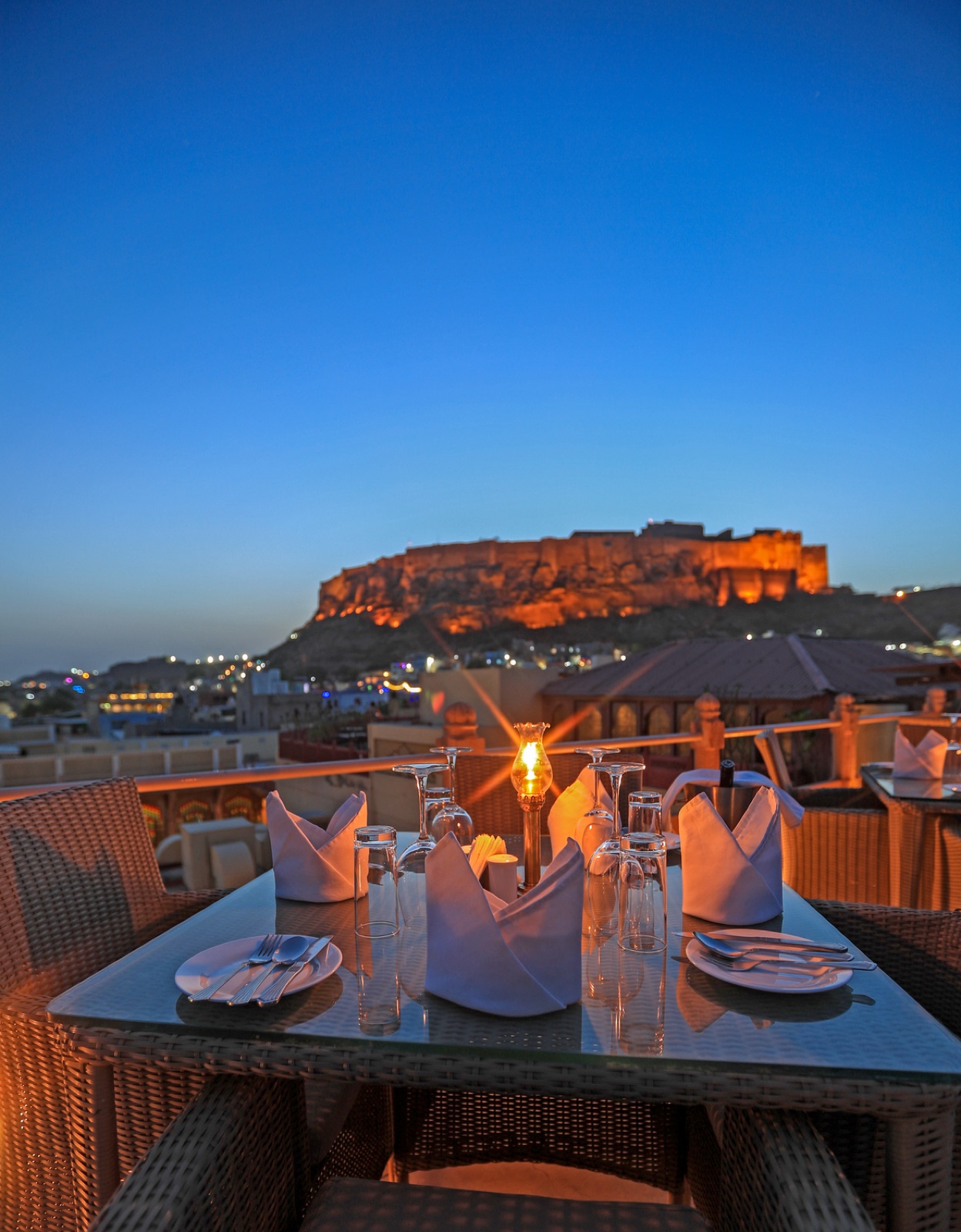
Below the fort, in the old city. Pal Haveli, 21 rooms in a 200-year-old Thakur family haveli with the fort filling the view from the roof. RAAS Jodhpur, forty rooms around an 18th-century haveli courtyard and a large pool, the fort walls above it. Both put you in the blue city on foot.
The 1920s palaces on Circuit House Road. Ranbanka Palace, a red-sandstone palace built for Maharajadhiraj Sir Ajit Singh of Marwar. Ajit Bhawan, the 1927 residence built for the same Maharaj. Karni Bhawan, a colonial bungalow in the middle of town. Gardens, pools, and a car into the old city in ten minutes.
Out in the country. Rohet Garh, four centuries of one family and a lakeside garh. Chandelao Garh, held by a Rathore family since 1744. Fort Chanwa, an 1894 fortified haveli. Fort Khejarla, a 1611 fort on a granite hillock. Mihir Garh, nine suites on a dune. Dhora Desert Resort, tents around a desert pond a hundred kilometres out. Mharo Khet, a forty-acre farm on the edge of the Thar. One night in any of these changes the trip. Back in town, Haveli Inn Pal, a haveli granted with the fiefdom of Pal in 1843, has a rooftop cafe facing the fort.
All fourteen, with what each is like.
Journeys through Jodhpur
Jodhpur sits on four of our Rajasthan journeys, two nights in each, with a private car and driver and the hotels named before you pay:
- Jodhpur & Jaisalmer, four nights, the blue city then the golden one
- Jaipur & Jodhpur, four nights
- Jaipur, Jodhpur & Jaisalmer, six nights, our pick
- The Rajasthan Grand Journey, ten nights
Or find a journey, weekend or city guide in three taps.
Is one day enough for Jodhpur?
One full day covers the fort, Jaswant Thada and the old city. It is a long day. Two nights lets you do the fort early, the lanes late and eat well in between.
Is the blue city really blue?
Parts of it. The blue is concentrated in the lanes directly below the fort on the north-west side, around Navchokiya. From the fort ramparts the whole old town reads blue; at street level it is patches, and finding them is part of the walk.
Can I see Jodhpur as a day trip from Jaipur or Udaipur?
Not sensibly. Each is five to six hours by road. Jodhpur needs a night, and it rewards two.
Which is better, a hotel in the old city or a palace hotel?
The old city puts the fort in your window and the lanes at your door, with smaller rooms and evening noise. The palaces on Circuit House Road give gardens, pools and quiet, with a ten-minute drive to the sights. First visit, short stay: old city. Longer stay, or travelling with older parents: the palaces.